There’s a story every hip-hop producer knows. You’re in a basement, or a dusty record shop, or a flea market at six in the morning. You pull out a dollar record with a water-stained sleeve. You’ve never heard of the artist. The genre says “easy listening.” Something tells you to flip it over anyway.
And there it is. Twenty seconds into the B-side: drums. Just drums. The band drops out, the drummer keeps going, and suddenly you’re holding pure gold.
That’s crate digging. That’s sampling. That’s how hip-hop was built.
Born from Necessity
Hip-hop didn’t start in studios with session musicians. It started in the Bronx, in communities that didn’t have access to expensive instruments or formal training. What they had: turntables, records, and imagination.
DJs noticed that the breakdown sections of funk and soul records—those moments when everything drops out except the drums—made people move harder than anything else. So they started looping those breaks, extending them, letting MCs rhyme over the rhythm.
The music came from records. Always from records.
Marley Marl Changes Everything
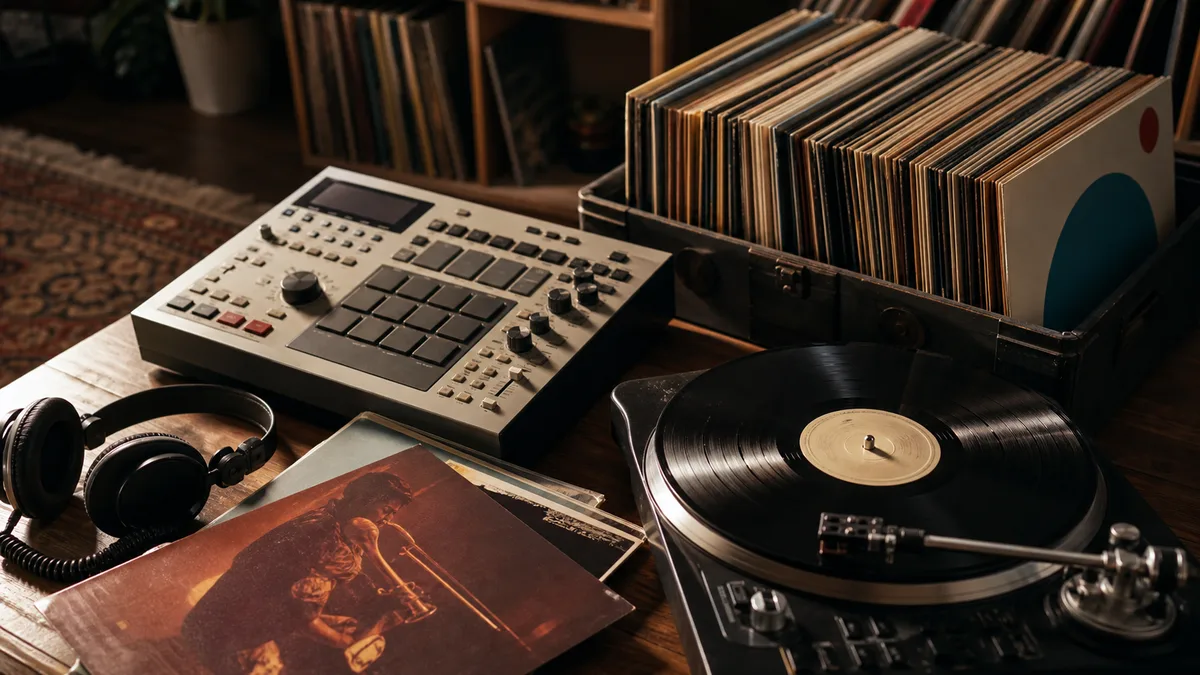
The leap from looping breaks to true sampling came from one producer’s curiosity. Marley Marl, working in his Queens apartment, figured out how to isolate individual drum sounds from records and trigger them with a drum machine.
This was revolutionary. Instead of looping someone else’s break, you could rebuild it from pieces. Take the kick drum from one record, the snare from another, the hi-hat from a third. Layer them into something new.
Suddenly, every record was a parts library. Every dusty 45 might contain the snare sound for the next classic.
The Wild West Years
Through the 1980s and into 1991, sampling had no rules. James Brown’s catalog was endlessly raided. Obscure funk records got chopped without a thought about licensing. The focus was pure creativity—what sounded good, what made people nod their heads.
Albums from this era are practically impossible to recreate today. The Beastie Boys’ Paul’s Boutique contains hundreds of samples. Public Enemy’s It Takes a Nation of Millions layered samples on top of samples on top of samples, creating sonic collages that remain staggering.
Nobody was asking permission. Nobody was paying royalties. The art was all that mattered.
Then the Lawsuits Came
In 1991, Gilbert O’Sullivan sued Biz Markie over an uncleared sample. The court didn’t just rule against Markie—the judge suggested criminal charges. The message was clear: sampling without permission was theft.
Overnight, everything changed. Those dollar records that producers had been chopping freely? Now they might cost thousands to clear. Some artists demanded 100% of royalties. Some refused clearance entirely.
The wild west was over. Producers had to adapt or quit.
The Art of Adaptation
Hip-hop didn’t stop. It evolved.
Chopping became an art form. Instead of looping obvious sections, producers sliced samples beyond recognition. Two notes of a piano. Half a vocal phrase. A bass hit pitched down so far the original was unrecognizable.
Interpolation emerged as an alternative—replaying elements from a song rather than sampling them directly. Different legal territory, different creative challenges.
Some producers dove deeper into obscurity. If you sampled from an album that sold 200 copies in 1973, nobody would recognize it. Nobody would sue.
The constraints shaped a new aesthetic. Producers got more creative because they had to.
The Legendary Breaks
Certain drum breaks became foundational. Any producer worth their salt knows them by heart.
“Funky Drummer” — James Brown. Clyde Stubblefield’s six-second drum break might be the most sampled piece of music in history. That syncopated pattern has appeared in thousands of tracks, from hip-hop to electronic to pop.
“Amen, Brother” — The Winstons. A seven-second drum solo by Gregory Coleman became the foundation of jungle, drum & bass, and countless hip-hop tracks. The original song was a B-side that went nowhere. That drum break shaped entire genres.
“Impeach the President” — The Honey Drippers. The boom-bap sound of late-80s and early-90s hip-hop? This is where it came from.
“Apache” — Incredible Bongo Band. From Grandmaster Flash to Nas, this break has been flipped more times than anyone can count.
The Masters at Work
Some producers elevated sampling from technique to art form.
DJ Premier built his sound on tiny fragments—a two-note guitar lick, a half-second of piano, a chopped vocal grunt. His work with Gang Starr defined East Coast hip-hop: gritty, immediate, unmistakable.
Pete Rock took the opposite approach. Long, lush loops from jazz and soul records, filtered and layered into something warm and sophisticated. His collaboration with CL Smooth on Mecca and the Soul Brother remains a masterclass.
RZA found samples where nobody else looked. Kung fu movie soundtracks. Obscure soul records. Eerie sound effects. The Wu-Tang Clan’s sound was cinematic because RZA treated his sampler like a film director uses a camera.
Madlib digs through everything—world music, jazz, electronic, psychedelic rock. His crate contains no boundaries. His productions sound like nothing else because his sources come from everywhere else.
Griselda’s production team proves crate digging never died. Their sound—raw loops, dusty drums, minimal processing—recalls the 90s while feeling contemporary. It’s proof that vinyl digging still produces heat.
The Hunt Itself
Before the internet, finding samples was its own adventure.
Producers spent hours in record stores, developing relationships with owners who might set aside promising finds. They hit flea markets at dawn. Thrift store bins. Estate sales where nobody else cared about the records.
You learned which labels consistently delivered. Stax for soul. Blue Note for jazz. CTI for fusion. You learned to check the credits—if the same session drummer appeared on multiple records, each was worth investigating.
The competition was real. Finding an unsampled break gave you something no one else had. Revealing your sources was like giving away a secret weapon.
Some producers still won’t tell you where their sounds come from. The code persists.
Vinyl’s Continuing Role
Digital sampling made everything accessible. Any song, any drum break, available instantly. So why do producers still dig through vinyl?
The sound, partly. There’s a warmth to vinyl, a compression, a texture that digital files don’t naturally have. Sampling from records captures that character automatically.
But it’s more than sound. The physical process changes how you discover. You can’t algorithm your way to a forgotten 45 from 1974. You have to touch it, flip it, drop the needle. That friction creates discoveries that playlists never will.
And when you find something special—when you pull a record from a dollar bin and hear something magical—that feeling is irreplaceable.
The Future of Sampling
AI-assisted discovery is coming. Copyright enforcement is getting more sophisticated. The legal landscape keeps shifting.
But the core appeal remains unchanged: finding a piece of music that moves you and transforming it into something new. That’s what hip-hop has always been. That’s what sampling will always be.
The tools evolve. The hunt continues. And somewhere, right now, a producer is flipping through a crate of records, looking for the next perfect sound.
Sources: Splice, Medium/Cuepoint, Tracklib, AllHipHop