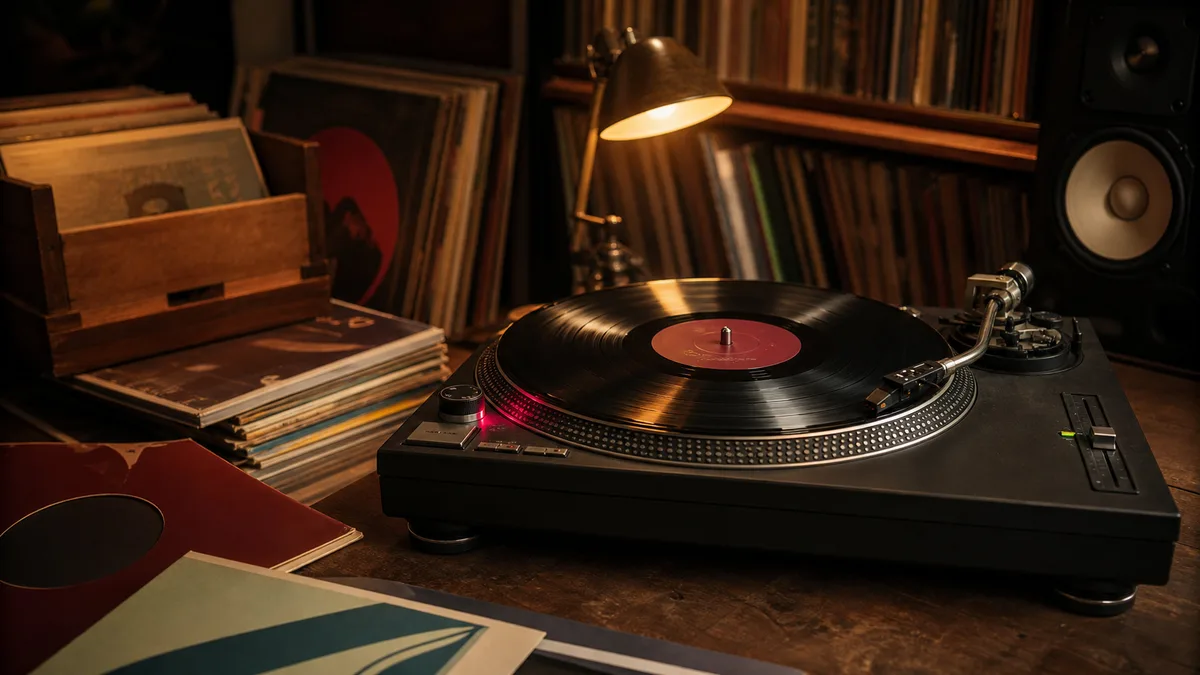
There’s a moment every DJ remembers: the first time they touched a Technics 1200. The weight of that tonearm. The smooth glide of the pitch fader. The way the platter responds to even the slightest touch. It feels like something built to last forever—because, in many cases, it has.
When Matsushita’s engineers designed the SL-1200 in 1972, they imagined hi-fi enthusiasts in quiet living rooms. They had no idea they were creating a cultural revolution.
A Party in the Bronx
August 11, 1973. A back-to-school party at 1520 Sedgwick Avenue in the Bronx. DJ Kool Herc stands behind two turntables, doing something nobody has seen before.
He’s playing the same break—that drum-heavy section where the song strips down to rhythm—from two copies of the same record, alternating between them to extend the moment. The crowd loses their minds. The breakbeat is born.
Hip-hop didn’t come from a studio or a record label. It came from block parties, from innovation, from DJs who saw turntables not as playback devices but as instruments.
And when those DJs needed equipment that could handle what they were doing? They reached for the Technics.
Why This Turntable?
The SL-1200 wasn’t designed for DJing. But it turned out to be perfect for it.
The direct-drive motor connected straight to the platter. No belt to slip or break when you scratch. No lag when you hit play. The torque was immediate, powerful, reliable.
The pitch slider let DJs match beats between records. The heavy construction absorbed vibrations—essential when bass is shaking the room. And the build quality? These machines could take punishment. Night after night, year after year, they kept working.
In 1979, Technics released the MK2. The pitch control got better. The tonearm improved. The iconic silver-and-black aesthetic arrived. And for the next thirty years, nothing else came close.
More than three million units sold. Many of them are still in use today, decades later.
When Turntables Became Instruments
What started as DJing evolved into something more. Turntablism—the word was coined by DJ Babu in 1995—describes using turntables to create music, not just play it.
The techniques that emerged are still jaw-dropping to watch. Scratching, where the DJ moves the record rhythmically while cutting the crossfader. Beat juggling, using two copies of a record to build entirely new patterns. Transforms, where rapid fader cuts create staccato effects that sound electronic but come from vinyl and human hands.
The DMC World Championships, starting in 1985, turned turntablism into competitive sport. DJs like Q-Bert, Mix Master Mike, and Craze pushed boundaries nobody knew existed. They proved that a turntable could be as expressive as any traditional instrument—maybe more.
The Pioneers
Grand Wizard Theodore discovered scratching by accident. He stopped a record to hear his mother calling, realized the sound had musical potential, and changed music forever.
Grandmaster Flash developed punch phrasing and quick mix theory—the foundational concepts that every DJ since has built upon.
Afrika Bambaataa blended funk, electronic music, and disco into something entirely new, using Technics decks as his palette.
Later, producers like DJ Premier, Pete Rock, and RZA turned sampling into high art. They’d find two seconds of a jazz piano buried on a forgotten record, pitch it down, layer it over dusty drums, and create something timeless. Their work began at the turntable, digging through crates, listening for potential.
Beyond Hip-Hop
The Technics became the backbone of electronic music too. House DJs in Chicago and New York needed beat-matched vinyl mixing—the 1200 delivered. Detroit’s techno pioneers ran their revolution on Technics decks. UK jungle and drum & bass demanded precision mixing; nothing else could keep up.
From Ibiza to Tokyo, the silver turntable became universal.
The London Science Museum displays an SL-1210MK2 (the black variant) as one of the technologies that “made the Modern World.” That’s not hype. This turntable genuinely changed how music is performed, created, and experienced.
The Dark Years
In 2010, Panasonic discontinued the SL-1200 series. Digital DJing had arrived. Sales were declining. The company moved on.
DJs panicked. Used prices skyrocketed. Alternatives existed, but they never felt quite right. There’s something about a Technics—the weight, the response, the absolute reliability—that competitors couldn’t replicate.
The Return
In 2016, Technics came back. The SL-1200G brought modernized specs while maintaining that classic feel. The SL-1200MK7 followed, designed specifically for DJs who’d never stopped asking for it.
The market had spoken clearly: nothing could replace the Technics.
Finding Your Own
For collectors and DJs hunting vintage units, options abound:
The SL-1200MK2 remains the classic. Widely available, well-supported by aftermarket parts, holds its value beautifully.
The SL-1210MK2—identical but black—appeals to those who prefer the darker aesthetic.
The SL-1200MK5 refined the design with improved pitch control and tonearm.
The SL-1200GLD, a limited gold edition, has become a genuine collector’s piece.
When buying used, check the pitch fader (it should respond smoothly), tonearm bearings (they should move freely), and platter wobble (there shouldn’t be any). These machines were built to survive decades of heavy use, but they’re not immortal.
The good news: parts and service remain available. Specialists like KAB USA can restore vintage units to factory condition. A well-maintained Technics can outlast its owner.
The Legacy
The SL-1200 transcended its origins as audio equipment. It became a musical instrument that helped create hip-hop, shaped electronic music, and continues to define what DJing means.
Over fifty years after its introduction, the Technics remains the standard. Other turntables may match its specifications. None match its soul.
When a DJ puts hands on those platters, they’re connecting to history—to block parties in the Bronx, to basement clubs where new genres were born, to decades of musical innovation built on a piece of equipment that keeps spinning.
That’s worth something that specs can never capture.
Sources: Wikipedia - Technics SL-1200, Technics Official History, The Vinyl Factory, Soundstage Hi-Fi