Every time you drop a needle on a record, you’re participating in a 140-year-old ritual. The technology has evolved, the materials have changed, the format has nearly died multiple times—but here we are, still spinning discs, still watching needles trace grooves, still experiencing music the way our great-great-grandparents first learned they could.
The story of how we got here is wilder than you might think.
Before Records Could Play Back
In 1857, a French inventor named Édouard-Léon Scott de Martinville created something remarkable: a device that could record sound. His Phonautograph etched sound waves onto soot-covered paper, creating visual representations of audio.
The catch? It couldn’t play anything back. These were recordings you could only see, not hear. They sat in archives for over 150 years until 2008, when scientists finally figured out how to digitally convert those etchings into audible sound. Imagine waiting a century and a half to hear what you recorded.
Then in 1877, Thomas Edison changed everything. His phonograph used a tin foil cylinder that both recorded and reproduced sound. He demonstrated it by reciting “Mary Had a Little Lamb”—the first recognizable audio ever played back for an audience. People lost their minds. A machine that could talk.
But cylinders were fragile, wore out quickly, and couldn’t be mass-produced efficiently. They were a dead end, technologically speaking.
The Flat Disc Changes Everything
In 1887, German-American inventor Emile Berliner figured out the crucial innovation: flat discs instead of cylinders. His Gramophone used 7-inch discs playing at 70 RPM, with lateral (side-to-side) groove cutting.
The magic wasn’t just the shape—it was what the shape enabled. Flat discs could be stamped from a master. For the first time, recorded music could be mass-produced. You could make a hundred copies, a thousand copies, a million copies. The music industry as we know it became possible.
The Shellac Era
By 1901, the Victor Company had standardized 10-inch discs playing at 78 RPM. These became the dominant format for nearly fifty years.
Shellac records were something else. Made from a resin secreted by lac bugs (seriously) mixed with various fillers, they were heavy, brittle, and prone to shattering if dropped. They held about 3-5 minutes per side. The needles were huge by modern standards, and you replaced them constantly.
But they worked. Recorded music became a mass phenomenon. The Victrola—which integrated turntable, tonearm, and acoustic horn into one elegant furniture piece—brought music into living rooms as respectable entertainment rather than carnival novelty.
Then radio emerged in the 1920s, and people predicted recorded music was finished. Free music broadcast through the air? Who would buy records? (They were wrong, but that wouldn’t be the last time the industry predicted its own demise.)
The Revolution of 1948
After World War II, Columbia Records engineer Peter Goldmark led a project that transformed everything.
The Long Playing record: 12 inches in diameter. 33⅓ RPM. Microgroove technology that packed 224 grooves per inch instead of 85. And crucially, made from polyvinyl chloride—vinyl—instead of brittle shellac.
The result: up to 21 minutes per side. An entire symphony on a single disc. Jazz sets without interruption. For the first time, artists could think in terms of albums as artistic statements, not just collections of singles.
Not to be outdone, RCA Victor introduced the 7-inch 45 RPM single the following year—perfect for pop songs and jukeboxes, cheap enough for teenagers, with that distinctive large center hole.
For years, consumers needed different players for different speeds. Format wars are nothing new.
The Golden Age
By the late 1950s, stereo arrived—two channels of audio encoded in a single groove using a clever V-shaped profile. Mono production continued until 1968, when major labels finally abandoned it for consumer releases.
The 1960s transformed the LP from delivery format into art form. Albums became cohesive artistic statements. Gatefold sleeves with elaborate artwork became standard. Progressive rock embraced the long-form possibilities. The album replaced the single as the primary unit of musical expression.
Manufacturing scaled massively. By the late 1970s, pressing plants were running around the clock. Millions of records shipped annually. Quality varied wildly—budget labels cutting corners, audiophile labels obsessing over every detail, import pressings from Japan and Germany gaining reputations for superior quality.
The Digital Apocalypse
The Compact Disc arrived in 1982, and the industry couldn’t promote it fast enough. “Perfect sound forever.” No surface noise. No wear from playback. Random track access. Smaller, more portable.
The message was clear: vinyl was obsolete. Replace your collection.
The numbers tell the story:
- 1978: 341 million vinyl LPs sold in the US
- 1988: 72 million
- 1993: 1.2 million
By the early 1990s, vinyl looked truly dead. Major labels stopped pressing. Record stores converted to CD-only. Pressing plants closed. Equipment manufacturers stopped making new machines.
And yet… some communities kept spinning.
DJs needed vinyl for turntablism and electronic music. Audiophiles insisted it sounded better and kept small labels pressing. Collectors understood that rare pressings held value regardless of format trends. Independent labels never entirely stopped producing limited runs.
Vinyl retreated underground, but it never quite died.
The Resurrection No One Expected
Something strange happened around 2007-2008. After decades of decline, vinyl sales suddenly increased. Not by a little—by 89% in a single year.
Why then? A few theories converge.
Digital music had fully triumphed, which paradoxically made physical media interesting again. iPods had replaced CDs, leaving vinyl as the only physical format with any cachet. Streaming was emerging, making music feel disposable—and making permanent physical objects feel more valuable by contrast.
Record Store Day launched in 2008, creating annual excitement around vinyl exclusives. Gen X buyers hit their nostalgic years with disposable income. Something cultural shifted.
The growth continued:
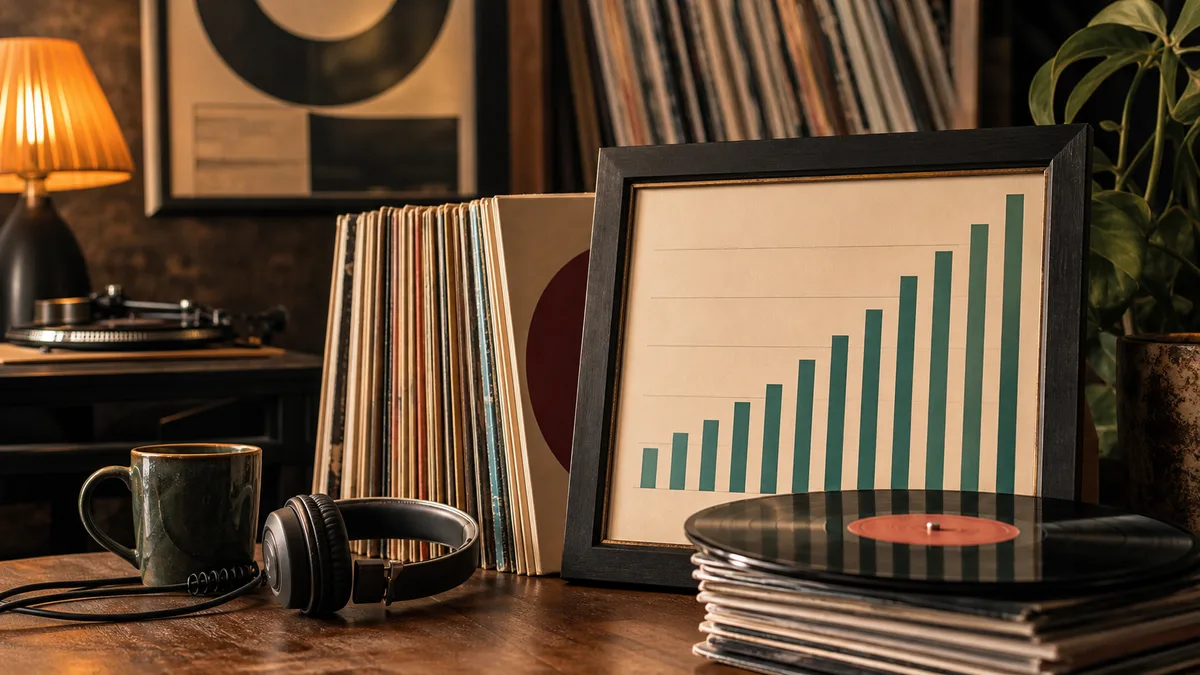
- 2007: 1 million units
- 2015: 12 million units
- 2020: 27 million units
- 2023: 49 million units
By 2024, vinyl revenue surpassed CD revenue for the first time since 1987. The format that was supposed to be dead had outlived its killer.
The Modern Era
The revival created new challenges. Demand exceeded pressing plant capacity. Lead times stretched to six months or more. When major artists dropped albums, their pressing runs consumed entire plant schedules for weeks, pushing everything else back.
But the industry adapted. Entrepreneurs commissioned new equipment, sometimes refurbishing Soviet-era presses. New plants opened. Competition drove quality improvements. The infrastructure slowly caught up with demand.
Why Did This Happen?
The vinyl revival reflects something bigger than audio preferences.
In a world of infinite streaming, ownership feels meaningful. You can hold a record. Display it. It’s yours in a way that a Spotify subscription never is.
The ritual matters. Choosing an album. Handling it. Dropping the needle. Sitting with the music. It’s the opposite of algorithmic playlists in the background.
The aesthetic dimension is real. Album artwork at 12 inches. Gatefold sleeves you can actually read. Colored vinyl that looks beautiful on the shelf. In an age of Instagram, vinyl photographs well.
And yes, some people genuinely believe it sounds better—or at least different in a way they prefer. Whether that’s technically true matters less than the experience of it.
The Ongoing Story
The vinyl revival shows no signs of stopping. New pressing capacity continues coming online. Artists treat vinyl releases as meaningful rather than nostalgic. Young collectors who’ve never known a world without streaming are discovering the format fresh.
Your collection is part of this story. Every record you own connects to this 140-year chain of invention, format wars, near-death experiences, and unexpected resurrections.
The next time you drop the needle, remember: you’re using technology that your great-grandparents would recognize. The grooves and the stylus and the spinning disc—it’s all still there, still working, still bringing music to life.
That’s pretty remarkable, when you think about it.
Sources: Disc Manufacturing Services, The Sound of Vinyl, Always the Holidays, AngelsHorn