There’s something almost magical about holding a vinyl record—this physical thing that somehow contains music. But what actually happens between an artist finishing a record and that album showing up at your local store?
The answer involves 150 tons of pressure, sapphire needles, electroplating baths, and a manufacturing process that’s remained remarkably similar for over half a century. It’s part science, part craft, and genuinely fascinating once you understand what goes into it.
It Starts With Specialized Mastering
Before anything physical happens, the audio needs to be prepared specifically for vinyl. This isn’t just copying the digital master—vinyl has quirks that require adjustments.
Bass frequencies have to be carefully managed; too much low-end creates grooves so wide the stylus can’t track them. Extreme stereo panning can cause similar problems. The running time on each side determines how loud the record can be—longer sides mean tighter grooves and lower volume. And dynamic range needs to fit vinyl’s physical limitations.
A skilled mastering engineer balances all of this while trying to preserve what makes the music special. It’s a genuine craft—one where poor decisions at this stage can doom the record regardless of how carefully everything else is done.
Here’s an interesting twist: vinyl masters often have better dynamics than streaming versions. The format physically can’t handle the extreme compression that’s become standard for digital releases. Vinyl’s limitations actually protect the music from the worst tendencies of the loudness wars.
Cutting the Lacquer
This is where audio becomes physical for the first time, and it’s one of the coolest parts of the whole process.
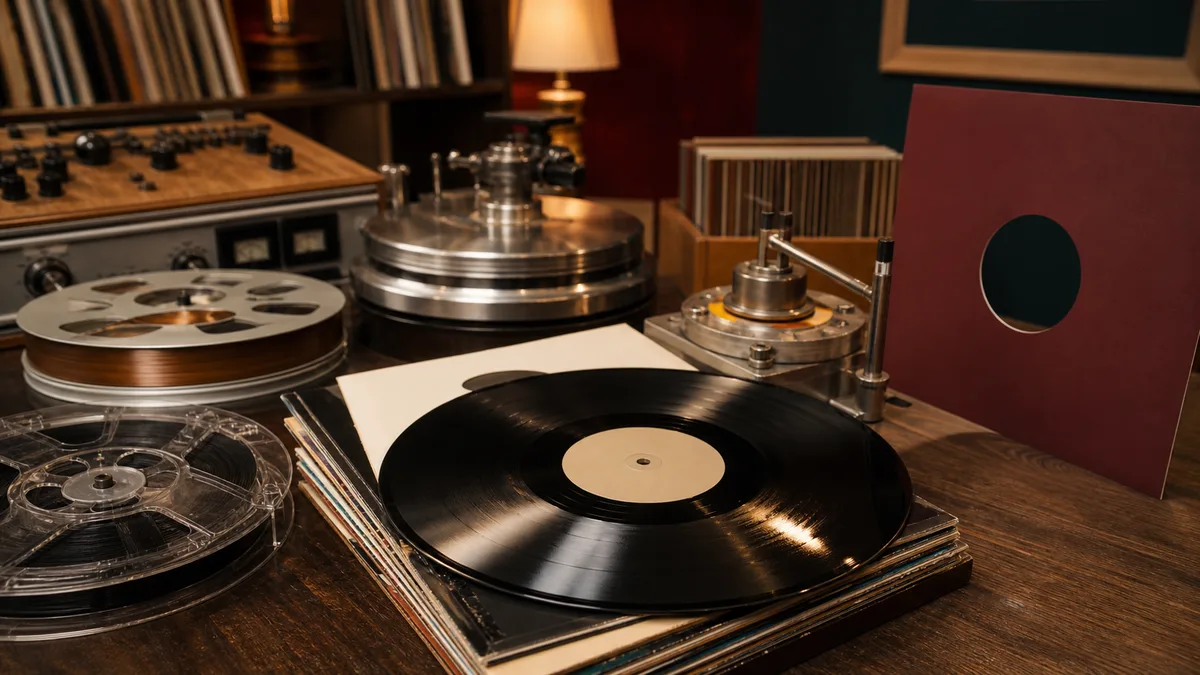
A precision lathe spins an aluminum disc coated with a soft nitrocellulose lacquer—the same stuff nail polish is made from, basically. A heated sapphire or diamond stylus sits on the disc, vibrating according to the incoming audio signal. As the lacquer spins at 33⅓ RPM, that stylus carves the music directly into the surface, creating a spiral groove that runs from the outer edge toward the center.
The key detail: this happens in real time. The cutting engineer plays the master from beginning to end, and the stylus carves as it goes. No stopping. No editing. If something goes wrong, you start over with a fresh lacquer disc—and those cost $100-200 each.
The resulting lacquer is incredibly delicate. It has to be handled with extreme care and processed quickly before the soft surface starts to degrade.
Creating the “Family”
Here’s where it gets weirdly beautiful. The lacquer can’t actually be used for pressing—it’s too fragile. Instead, it becomes a template for creating metal parts through electroplating.
First, the lacquer gets sprayed with a thin layer of silver to make it conductive, then immersed in an electroplating bath where nickel builds up on the surface. This creates what’s called the “Father”—a metal negative of the lacquer, where grooves have become ridges.
The Father is then used to create a “Mother”—a positive copy where grooves are grooves again. And the Mother produces the actual “Stampers” that will press records—negative copies with ridges that will impress grooves into fresh vinyl.
Why all this complexity? Each stamper can only press 500-1,000 records before the detail starts degrading. For any significant pressing run, you need multiple stampers. The Mother allows creating new stampers without going back to the original fragile lacquer.
Pressing plants talk about the “family” with real affection. There’s something almost biological about it—parent to child, generation to generation.
The Pressing
This is the dramatic part. 150 tons of pressure, scalding heat, and about 30 seconds per record.
PVC pellets (often including up to 25% recycled vinyl from rejected pressings) get fed into a hopper and heated to around 300°F. The melted plastic gets extruded into a warm puck called a “biscuit.”
Meanwhile, the pre-baked labels are positioned above and below the biscuit, and the stampers for Side A and Side B are loaded into the press.
Then the press closes with enormous force—150 tons squeezing that soft vinyl between the two stampers. Hot steam keeps everything malleable while the grooves form; cold water sets the shape. Excess material (“flash”) gets trimmed from the edges, and a finished record drops onto a spindle.
The whole cycle takes about 30 seconds. A skilled operator running a single press can produce over 1,000 records in a day. Watch video of the process sometime—there’s something deeply satisfying about seeing those fresh records stack up.
Quality Control
Not every pressing makes the cut.
Records come off the press and get inspected visually for warps, bubbles, and surface defects. Roughly every 50th record gets actually played on a turntable, with inspectors listening for surface noise, distortion, and any pressing defects.
Records that fail inspection get recycled—melted back down into raw material for future pressings. Nothing goes to waste.
Before full production runs begin, test pressings are sent to the label and artist for approval. These are the first actual records made from the stampers, and the people who made the music get to confirm it sounds right before thousands of copies get produced.
The Human Touch
After all that industrial machinery, packaging is surprisingly manual.
Someone has to put each record into an inner sleeve. Someone has to slide that inner sleeve into the printed jacket. Someone has to make sure everything’s aligned before the package goes through the shrink-wrap machine and gets boxed for shipping.
Despite all the automation elsewhere in the process, human hands handle every record before it reaches you. There’s something nice about that.
Why Releases Get Delayed
If you’ve ever wondered why limited releases sell out instantly, or why your pre-ordered album keeps getting pushed back, the answer is infrastructure.
There are only about 30 major pressing plants worldwide. Many are running refurbished 1970s equipment—the original manufacturers stopped making new presses decades ago. The skilled engineers who know how to operate and maintain this stuff are retiring faster than new ones can be trained. PVC prices and shipping costs have risen.
Lead times of 4-6 months for new releases are normal now. When Taylor Swift drops a new album, her pressing run can consume an entire plant’s capacity for weeks, pushing everything else back.
The vinyl revival has been wonderful for the format’s survival—but the infrastructure hasn’t kept up with demand.
Why Any of This Matters
Understanding manufacturing changes how you experience records.
Knowing that pressing plant quality varies helps you appreciate why some labels command premium prices. Understanding that first pressings use fresh stampers explains why collectors chase them. Recognizing that a record traveled through electroplating baths and 150-ton presses to reach you makes the physical object feel more remarkable.
The next time you drop the needle, consider the journey. From a recording studio to a mastering suite. Through a cutting lathe and electroplating tanks. Pressed under enormous force in a noisy factory. Handled by human workers who packaged it for shipping. All of that—to bring music into your home.
It’s a beautiful thing, really.
Sources: Fluance, United Record Pressing, Disc Makers, Furnace MFG