Remember when people thought vinyl was dead? That streaming would completely wipe out physical media? Well, about that…
We’re now eighteen years into what can only be called a full-blown vinyl resurrection. The numbers coming out of 2025 would’ve sounded like fantasy a decade ago. And the really wild part? It doesn’t look like it’s slowing down.
The Numbers Are Kind of Insane
Let’s just lay out what’s happened: the global vinyl market is now worth somewhere around $2.4 billion. Analysts expect it to hit $3.5 to $5 billion by the early 2030s. We’re talking growth rates between 7 and 11 percent every year, compounding.
To put that in perspective, there was a point in the mid-2000s when major labels were seriously considering stopping vinyl production altogether. Now it’s outpacing CDs in revenue. In 2024, vinyl brought in $1.4 billion compared to CDs’ $541 million. Nobody saw that coming.
Q3 of 2025 alone moved nearly 1.5 million records. Year-to-date is approaching 4.7 million, and the industry’s on track to clear 7 million units for the full year. Not bad for a “dead” format.
The Comeback Nobody Predicted
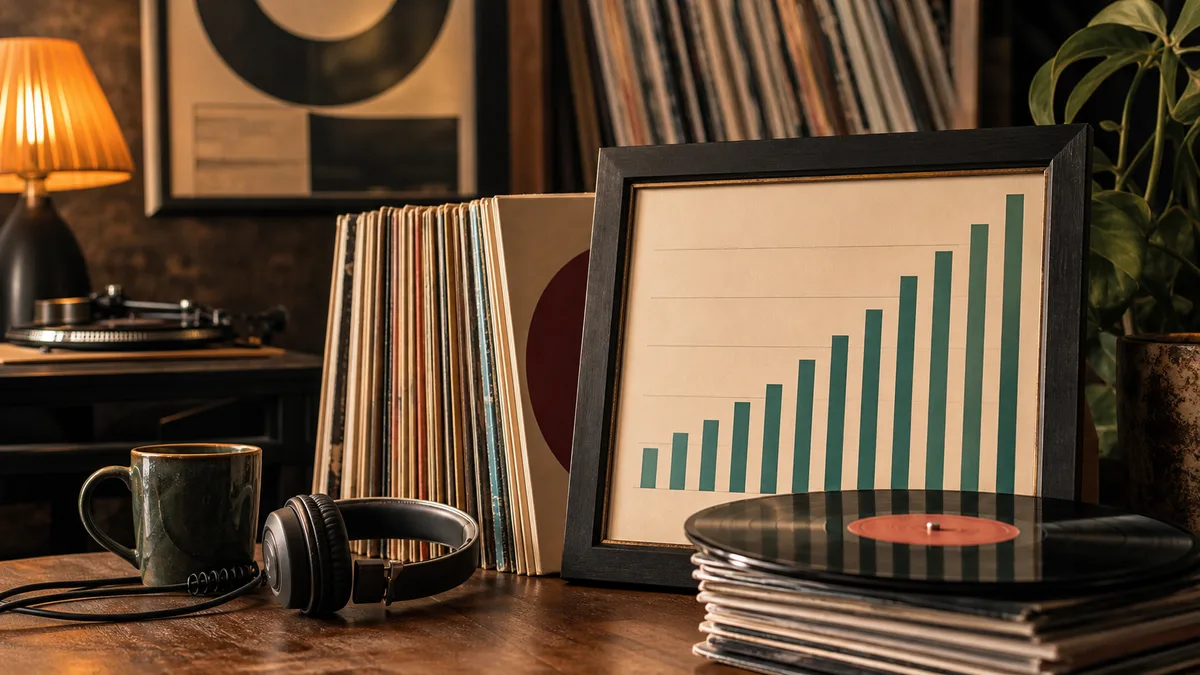
Here’s what the trajectory looks like over the past several years: in 2016, the market sold about 13 million units. By 2023, it was pushing 50 million. That’s nearly 300% growth in under a decade.
There was a small dip in early 2024 that made some people nervous—maybe the bubble was finally bursting? But no. The market bounced back strong, proving that this isn’t a fad. It’s something more fundamental.
Why Is This Happening?
A few theories that probably all contain some truth:
Streaming made music disposable, and people want the opposite. When everything is available instantly and infinitely, nothing feels special. Vinyl forces you to commit. You bought this album. You’re going to sit down and listen to it. There’s a ritual to it—sliding the record out, dropping the needle, sitting with the music for a full side. In a world of infinite skips, that intentionality feels almost radical.
The sound quality thing is real, even if it’s complicated. Does vinyl technically sound “better” than a high-res digital file? Audiophiles can argue that for hours. But does it sound different in a way many people prefer? Absolutely. There’s a warmth, a presence. Whether that’s the format itself or just the psychology of paying attention, the experience resonates with people.
Collecting is fun again. Limited pressings, colored variants, Record Store Day exclusives—there’s a thrill to the hunt. Finding that record you’ve been looking for, or stumbling onto something you didn’t know you needed. You can’t really collect Spotify streams.
Gen Z got into it. Plot twist of the decade: the generation that grew up entirely digital has developed a genuine affection for analog. Film cameras, instant photography, and yes, vinyl records. The “retro” appeal mixed with the tactile experience seems to hit something that purely digital never could.
Artists actually care about it. Major acts put real thought into their vinyl releases now. Special editions, quality pressings, albums designed to be experienced as vinyl. When Taylor Swift drops an album, the vinyl version sells out instantly. Post Malone was this year’s Record Store Day ambassador. These aren’t legacy acts being nostalgic—it’s current artists treating the format as something worth attention.
The Record Store Renaissance
Here’s a stat that feels genuinely heartwarming: independent record stores now account for about 40% of all vinyl sales. Not Amazon. Not Target’s record section. Actual local shops with knowledgeable staff and crates to dig through.
Record stores have transformed from dusty relics into community hubs. People go not just to buy records, but to discover music, talk to fellow collectors, attend listening parties. It’s become a social experience in a way that clicking “add to cart” never can be.
The Catches
It’s not all rosy. A few realities temper the enthusiasm:
Getting records pressed is still a nightmare. There just aren’t enough plants to meet demand. Indie artists sometimes wait six months or more. This creates delays, drives up prices, and frustrates everyone.
Prices keep climbing. A new LP that cost $20 a few years ago might run $30-35 now. Raw materials, energy costs, and demand all push prices higher. It’s making the hobby less accessible than it used to be.
Let’s be honest about scale. Streaming still accounts for 96% of music listening in the US. Vinyl is growing, but it’s a niche—just a more vibrant, passionate niche than anyone expected.
What It Means If You Collect
For those of us already in this world, or thinking about getting in:
Expect prices to keep rising, especially for limited stuff. If you see a pressing you want, don’t assume you can grab it later. The “I’ll get it next month” approach has burned a lot of collectors.
Quality matters more as more records get pressed. A lot of what’s hitting shelves is genuinely well-made. But there’s also cheap cash-grab vinyl that sounds worse than the streaming version. Know what you’re buying.
The community’s bigger than ever. More people to trade with, talk to, share discoveries with. Local scenes are thriving. Online communities are active. It’s a good time to be into this.
And as always—collect what you love. The investment angle is real, but it shouldn’t be the point. The records that bring you joy are worth more than their Discogs price.
Stay in the Loop
Apps like My Vinyl+ make it easy to track what your collection’s actually worth in real-time. It’s useful for insurance purposes, for knowing when something you own has spiked, or just for the satisfaction of watching your shelves gain value while you enjoy them.
But the real value isn’t the number. It’s the music.
Sources: IMARC Group, Accio Business Trends, Music Week, Luminate Data