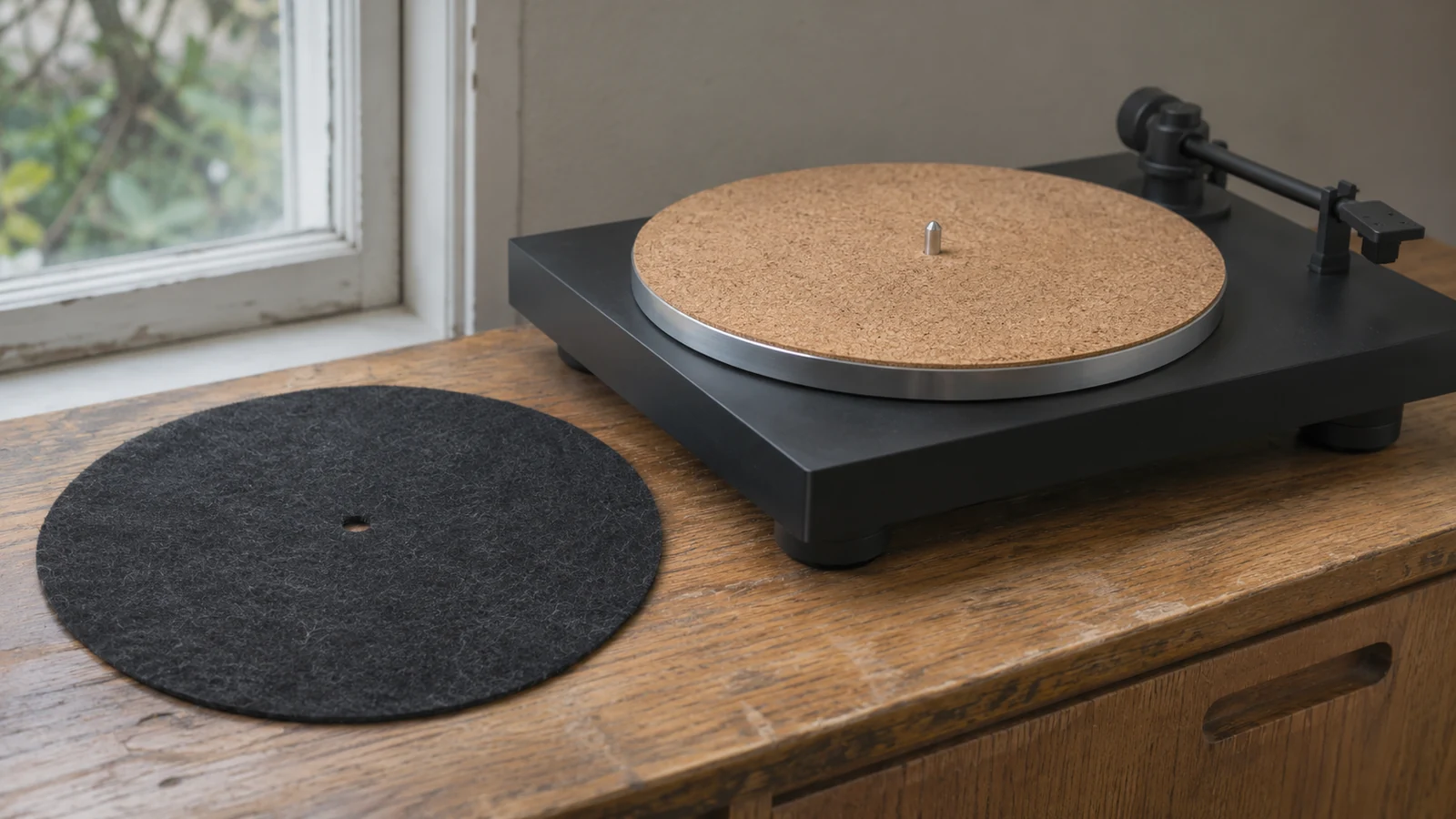
A replacement turntable mat looks like an accessory you can swap without changing anything else. Lift off the felt, put down the cork, and play a record. I would check one measurement before doing that, because the new mat also sets the height at which the record meets the stylus.
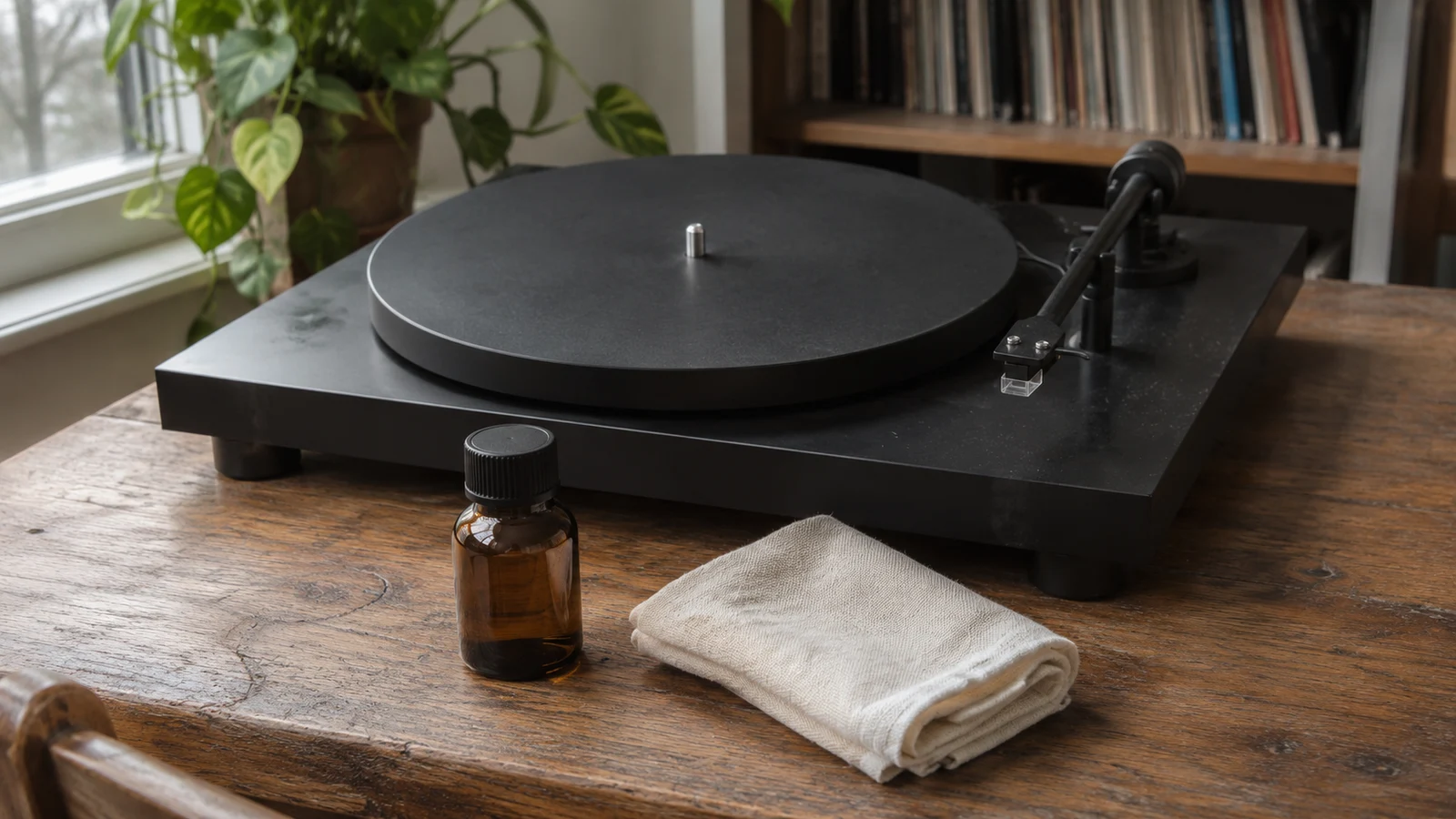
Pro-Ject’s Debut Carbon The Original appears in Gear Patrol’s November 9 roundup of new turntables.[1] Its manufacturer specifies a steel platter with a supplied felt mat.[2] Before replacing that felt with another material, check the new mat’s height as well as its fit. The same check applies to a deck you already own.
Start with thickness, not material
Audio-Technica’s platter-mat guidance lists several factory thicknesses, including 2.5 mm for its felt mat, 3 mm for the AT-LPW range’s rubber mat, and 5 mm for the AT-LP5X’s rubber mat. The company explains that those choices keep the tonearm parallel to the record during playback, with normal variation between records of different thicknesses.[3]
That makes “a rubber mat” an incomplete description of a replacement. The same material does not establish the same thickness, and a different material does not necessarily mean a thicker mat. Pro-Ject’s Cork it, for example, has a published thickness of 1.5 mm.[4] That dimension is more useful for checking compatibility than an unsupported promise about warmer sound.
If your arm has no height adjustment, Audio-Technica advises choosing a replacement of the same thickness as the original.[3] I would start with the turntable manual or the original mat’s specification, then check the proposed replacement. If either figure is missing, ask the maker before ordering rather than judge thickness from a product photograph.
Check what your tonearm actually allows
Changing the mat moves the record surface relative to the arm’s mounting point. Tonearm height adjustment lets you address that relationship, but the presence of a counterweight does not tell you whether the arm base moves. Find the section for arm height or vertical tracking angle in your exact model’s instructions.
The Debut PRO B manual gives a specific example. It says to check the arm tube with a record on the platter, the stylus in the groove, and the arm clear of the cueing support. Its starting position is parallel to the record surface. The manual then describes adjustment at the arm base and warns against excessive tightening.[5]
Those instructions belong to the Debut PRO B, not every deck carrying a Debut name. Do not loosen screws on another model because they look similar. Pro-Ject also advises owners who are unsure about cartridge and arm adjustments to use a dealer.[5] A mat change does not require you to learn an undocumented adjustment by trial and error.
I would use the manufacturer’s parallel-arm instruction as a setup reference, not claim that a glance at the arm measures the stylus’s exact contact angle. This is a compatibility check before listening, not a reason to chase tiny angle changes on every LP.
Check fit before the stylus touches down
Thickness is the first question, but I would also check whether the replacement sits flat and clears the spindle without force. With the turntable stopped and the arm secured, look for an edge caught on part of the platter or a center hole that prevents the mat from settling. Do not use a record to press an ill-fitting mat into place.
Treat the new mat as a replacement unless the turntable or accessory maker explicitly specifies a layered arrangement. Leaving the original underneath creates a different total height from the replacement mat’s published thickness. A photograph of a mat sitting on another mat is not an instruction for your deck.
Before playback, use the cueing lever to check that the stylus clears the record when raised. When lowered for the manual’s arm-height check, the arm must come clear of its lift support, as Pro-Ject’s instructions specify.[5] If it cannot do both, stop rather than compensate by adding tracking force or moving unrelated adjustments.
Make one reversible change
Here is the sequence I would use for a first replacement. Keep the original mat nearby so that stopping the experiment does not become another shopping decision.
- Find the exact turntable manual and record the original mat’s thickness. Confirm whether arm-height adjustment exists and whether the manufacturer permits the proposed change.
- Check the replacement’s stated thickness and diameter. For a fixed-height arm, follow the maker’s compatibility guidance rather than assume that a small difference cannot matter.
- Stop the platter, remove the record, and secure the arm. Fit the stylus guard if your cartridge has one and its instructions permit it while the arm is parked.
- Remove the original mat and fit the replacement. Check that it rests flat before putting a record on it.
- Remove the guard before any cueing check. Follow your manual’s procedure for checking arm height and clearance. Lift and secure the arm before making an adjustment, and make only adjustments the manual documents. Use a dealer if the procedure is unclear.
- Listen to a familiar passage, then make a short note of the mat and any setup changes. If returning to the original, restore any arm-height setting you changed as well.
Do not change the cartridge, add a record weight, and replace the mat in the same comparison. I want to know whether this particular change is worth keeping, which becomes harder to judge when several things change together.
Keep sound claims proportional
A mat comparison can be interesting without establishing a universal winner. In his July 2014 Analog Planet comparison, Michael Fremer published reader preferences from recordings made with different mats. He explicitly described it as not a scientific experiment, and some participants reported hearing no difference.[6]
That is historical listening context, not evidence that a particular mat will improve your turntable today. A home comparison can help you decide which setup you prefer. It cannot establish that cork, rubber, or felt is best for every turntable.
If the reason for changing the mat is distortion near a side’s ending, start with the Journal’s inner-groove distortion troubleshooting guide. A new accessory should not replace finding out which records and passages produce the symptom.
Before buying a mat, write down the original thickness and find out whether your arm height is adjustable. Those two answers will tell you more about a sensible replacement than a material ranking. Keep the original until the new mat fits, the cueing checks pass, and you have a specific reason to leave it installed.
Sources
[1] Gear Patrol: The coolest new turntables released in 2026, updated November 9, 2026
[2] Pro-Ject Audio Systems: Debut Carbon The Original, platter and supplied mat specifications
[3] Audio-Technica: Can I use a different platter mat on my turntable?
[4] Pro-Ject Audio Systems: Cork it, dimensional specifications
[5] Pro-Ject Audio Systems: Debut PRO B user guide, arm-height adjustment and setup precautions, 2024
[6] Analog Planet: Michael Fremer’s mat comparison results, July 21, 2014