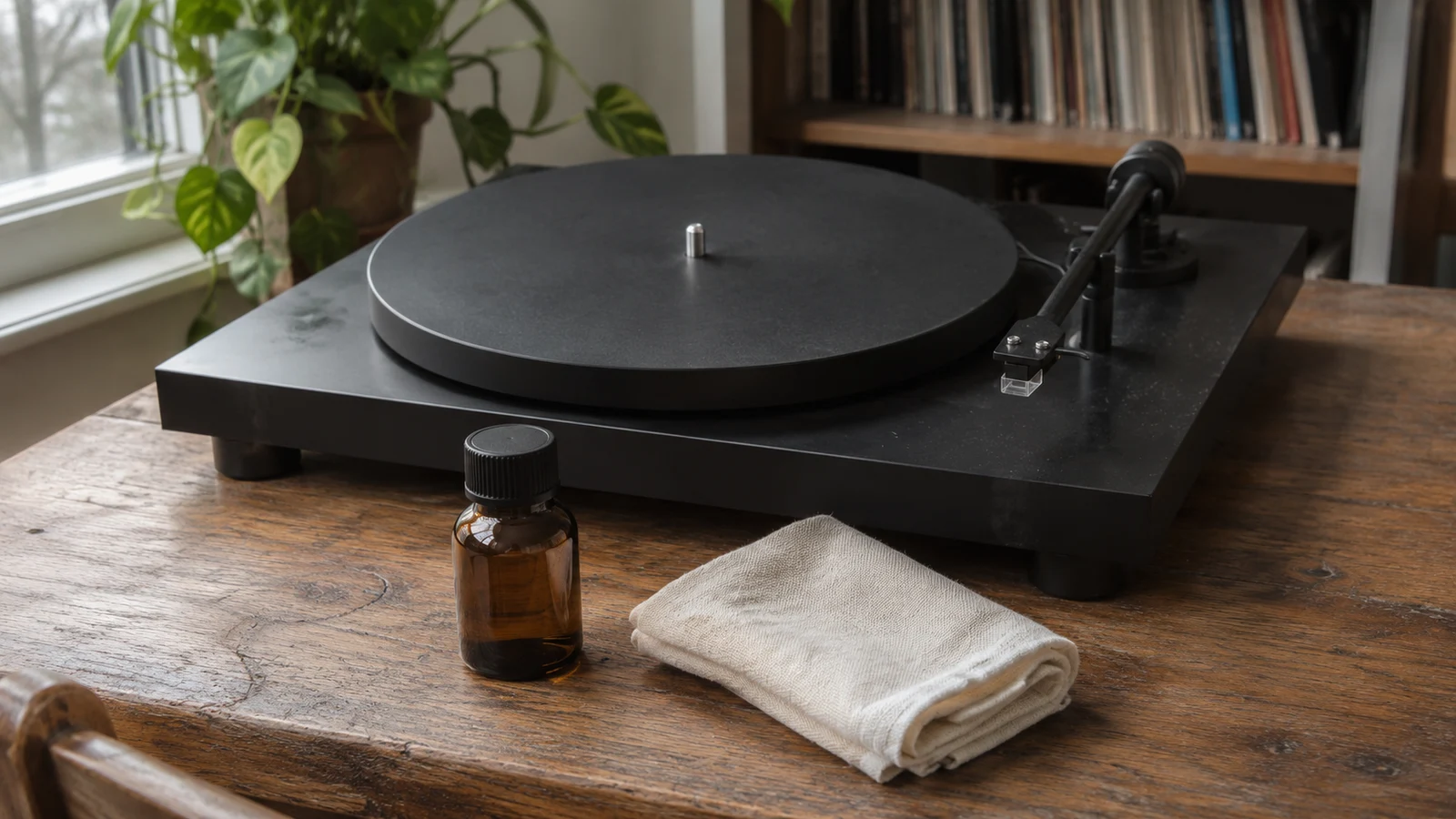
A small bottle of turntable bearing oil looks like an easy maintenance job. The difficult part comes before opening it. Does your particular bearing need that lubricant, and does the manufacturer expect you to reach it yourself?
I would answer those questions before lifting anything. Michael Fremer’s 2012 Analog Planet warning shows a damaged bearing reportedly run without oil. He also makes an essential qualification. Not every bearing requires oil.[1] The useful lesson is to find the correct service instructions, not oil every turntable on the shelf.
Identify the model and the part
Start with the exact model designation, its revision if known, and any record of modifications. A familiar name on the plinth is not enough to identify the mechanism inside. Stereophile’s account of the Garrard 301 explains that the earlier Schedule 1 used a grease bearing, while the Schedule 2 introduced an oil bearing in 1957.[2] Even one model family can require different maintenance.
For a used deck, I would ask whether the platter bearing remains original. An aftermarket bearing needs its own instructions, rather than assumptions carried over from the turntable’s original manual. Keep a photograph of the model plate and any service paperwork with your notes.
Be precise about the part too. This article concerns the main bearing that supports platter rotation. It is not a procedure for lubricating the motor, tonearm bearings, or cueing mechanism. Permission to service one component does not give you a method for the others.
Check whether the hub should come out at all
Removing a platter and withdrawing its bearing shaft are different operations. Do not assume that because one part lifts off, the next part should follow. Read the access instructions before trying to expose the lubricant.
Rega’s Planar 78 manual gives a clear example. It tells owners not to lift the center hub out of the main bearing because the factory-applied film of special thick lubricant may be disturbed, potentially affecting the turntable’s accuracy.[3] That is a model-specific instruction to leave an assembly alone, not an invitation to inspect it annually.
The same manual directs owners with problems to a Rega dealer and warns that unauthorized repair or modification may invalidate the guarantee.[3] I would take that warning seriously even if a video makes dismantling look simple. If your own manual draws a boundary around user maintenance, stop at that boundary.
Match the lubricant to the bearing design
Pro-Ject’s maintenance sheet distinguishes two arrangements. In its conventional bearing description, the axle belongs to the platter or subplatter and the bearing housing sits in the chassis. In the inverted arrangement, the axle sits on the chassis and the housing belongs to the platter.[4] That distinction changes the company’s lubricant recommendation.
Its Lube it page assigns that oil to listed conventional-bearing models, including the Debut family and X1/X2. It directs owners of inverted-bearing models, including the RPM, Xtension, and Signature lines, to Grease it instead.[5] These are compatibility instructions for those products, not proof that one bottle suits another manufacturer’s deck.
Viscosity can matter within a specific design too. In his 2019 Stereophile review of the aftermarket Buddha Bearing, Art Dudley describes tight clearances and the manufacturer’s advice about lubricant choice in colder conditions.[6] I would not copy the oils mentioned there into an unrelated turntable. The example explains why a general instruction to add a few drops leaves too much unanswered.
Before buying anything, establish the approved lubricant, where it goes, and the amount and application method. If the instructions do not answer those questions, ask the manufacturer or a qualified service technician. A bottle labeled for turntables is not a substitute for that information.
Do not invent a universal service interval
A calendar reminder helps only when it refers to the correct maintenance task. Pro-Ject’s maintenance sheet recommends renewing bearing lubrication after three years at the latest.[4] Its current Lube it page, however, says that climate and humidity affect lubrication and that it cannot give a recommended replacement time.[5] Those documents do not provide one consistent interval to apply without checking.
I would resolve that difference through the current instructions for the exact model or a written answer from support. I would not average the advice, choose the shorter interval automatically, or extend either statement to other brands. The Planar 78’s warning against withdrawing its hub already shows why a universal three-year dismantling routine would be inappropriate.[3]
For a secondhand turntable with no service history, write down that the last service date is unknown. Do not turn the purchase date into a claimed lubrication date. That small distinction helps a technician decide what still needs inspection.
Use a checklist before opening the bottle
This is the preparation I would do before any approved bearing service. It should also tell you when the job needs to stop before disassembly.
- Record the full turntable model and identify any replacement bearing. Find the relevant owner’s instructions and any separate bearing documentation.
- Confirm that the manufacturer allows owner access to the bearing. If the manual says not to withdraw the hub, leave it seated.
- Confirm the lubricant specification, application point, amount, and any cleaning instructions. Do not substitute a household spray or an oil mentioned in a review of another design.
- If proceeding with an authorized procedure, disconnect power, remove the record, and secure the tonearm as the manual directs. Prepare a clean work area before removing permitted parts.
- Follow only that procedure. If a part resists movement or the instructions no longer match what you see, stop and contact support rather than add force.
- Record the date, lubricant used, and work completed. Keep the manufacturer’s answer with the service note so the next decision does not depend on memory.
I would photograph the intact setup beforehand, but a photograph cannot authorize a repair or tell you a torque setting. It is a reference for the work you are already permitted to do.
Treat a fault as a reason to diagnose, not add oil
Fremer’s damaged-bearing example involved an owner repeatedly breaking and replacing belts before a manufacturer’s representative identified the bearing problem.[1] It is a useful warning against replacing the most visible part without finding the cause. It does not establish that every belt failure or slow platter means a dry bearing.
If the reason you reached for oil was wavering pitch, first use the Journal’s turntable speed troubleshooting guide to separate record-specific symptoms from a deck-wide problem. Keep your observations for the technician. Do not add lubrication as a test when the correct product or access method remains unknown.
Leave the bottle capped until you can name the bearing, the approved lubricant, and the documented procedure. Your next action may be a scheduled service, a question to the manufacturer, or leaving a factory assembly untouched. Knowing which one applies is the maintenance decision that comes first.
Sources
[2] Stereophile: Spin Doctor #25, The Garrard 301 in a New Light, page 2
[3] Rega: Planar 78 owner’s instructions, hints, tips, and service warning
[4] Pro-Ject Audio Systems: Turntable maintenance rules, bearing lubrication
[5] Pro-Ject Audio Systems: Lube it, lubricant compatibility and maintenance guidance
[6] Stereophile: Art Dudley, Listening #201, the Buddha Bearing, August 20, 2019