The first turntable setup is exciting and terrifying in equal measure. There’s the thrill of finally getting into vinyl, mixed with the creeping fear that you’re about to spend money on the wrong stuff. Everyone’s got opinions. Forums are full of conflicting advice. And the terminology alone—phono preamp, tracking force, anti-skate—can make the whole thing feel way more complicated than it needs to be.
Here’s the thing: it’s really not that complicated. Let’s cut through the noise.
How Sound Gets From Groove to Ear
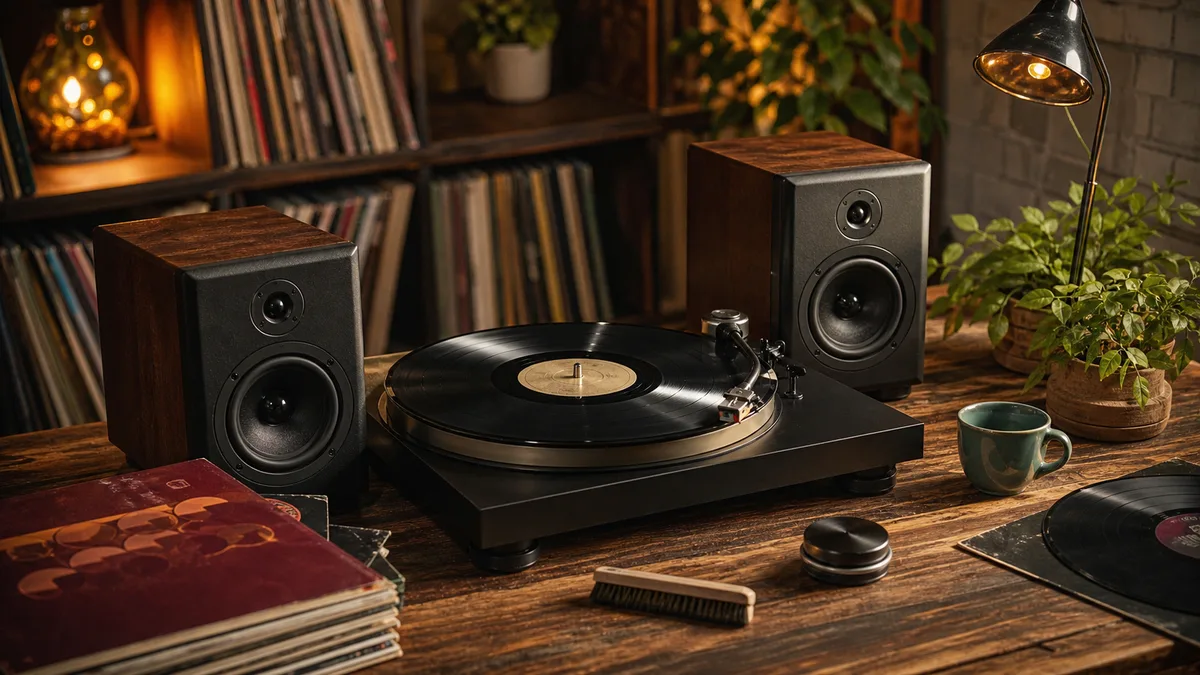
Every vinyl setup follows the same basic chain:
Turntable → Phono Preamp → Amplifier → Speakers
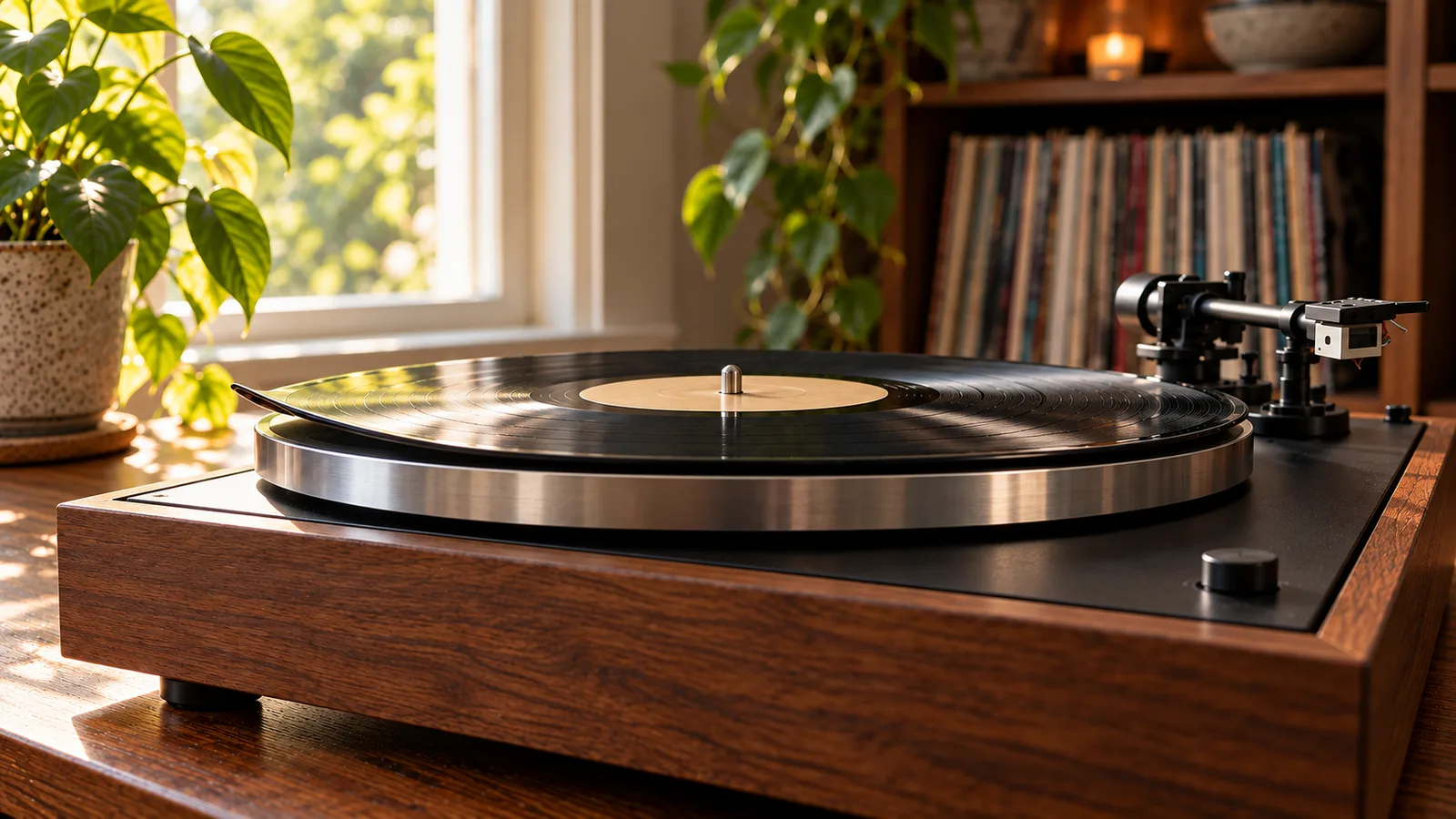
The turntable reads the groove with a stylus. That signal is very quiet and needs to be boosted by a phono preamp. Then it goes to an amplifier (or powered speakers have this built in), and finally out to the speakers.
Some gear combines multiple steps. Lots of entry-level turntables have the phono preamp built in. Powered speakers have the amplifier built in. You can keep things simple or go full separates—the sound gets better as you go up, but so does the complexity and cost.
The Turntable: Where It All Starts
This is the most important piece. A good turntable with mediocre speakers will sound better than a mediocre turntable with good speakers. Spend here first.
If Your Budget Is Tight ($100-250)
The Audio-Technica AT-LP60X (around $150) is the sensible default. It’s fully automatic, has a built-in preamp, and just works. It’s not fancy, but it won’t destroy your records and it sounds decent. A lot of collectors started here.
The Pro-Ject Primary E ($200-ish) sounds noticeably better but requires manual operation. If you want better audio and don’t mind lifting the tonearm yourself, it’s worth the step up.
If You Can Stretch ($250-500)
This is the sweet spot where things get genuinely good.
The Fluance RT81 or RT82 ($250-350) offers incredible value—solid wood plinth, belt drive with good isolation, and a cartridge you can upgrade later. People swear by these.
The Audio-Technica AT-LP120XUSB ($350) is the classic workhorse. Direct drive motor (if you ever want to DJ), built-in preamp with bypass for future upgrades, and USB output if you want to digitize your collection. It’s the Swiss Army knife of turntables.
If You’re Going Serious ($500-1000)
The Rega Planar 1 ($500) is where the audiophile world really begins. It’s elegant, sounds crystal-clear, and has a devoted following. There’s a reason reviewers praise it year after year.
The Pro-Ject Debut Carbon Evo ($600) takes it further with a carbon fiber tonearm that reduces resonance. The sound quality at this level can genuinely last you decades.
A word of warning: Avoid those cute suitcase-style all-in-one players no matter how aesthetically pleasing they look. Heavy tracking force, terrible needles, built-in speakers that vibrate the whole unit—they’re bad for your records and they sound awful. A cheap separates setup will always beat them.
The Phono Preamp Situation
Here’s where people get confused. Records produce a very quiet signal that needs specific boosting (called RIAA equalization). You need a phono preamp somewhere in your chain.
Option 1: Your turntable has one built in (the AT-LP60X and AT-LP120X do). Just flip the switch to “line” and you’re good.
Option 2: Your receiver or amplifier has a “phono” input. Plug directly into that.
Option 3: You buy an external phono preamp. This gives you the best sound and most flexibility.
If you’re starting out, options 1 or 2 are fine. If you want to upgrade later, an external preamp like the Art DJ Pre II ($50) or the Schiit Mani 2 ($150) makes a noticeable difference.
Speakers: The Final Link
You’ve got two paths: powered speakers (simple) or passive speakers plus an amplifier (better sound potential, more complexity).
For powered speakers, the Edifier R1280DB ($130) is hard to beat for the money. Good sound, built-in Bluetooth if you want it, and a basic EQ to tune things. The Kanto YU4 ($350) steps it up considerably with better drivers and more inputs.
For passive speakers plus amp, you’re looking at something like the Sony SSCS5 speakers ($150/pair) with a Fosi Audio BT20A amp ($70). Or the excellent ELAC Debut 2.0 B6.2 ($350/pair) with an SMSL SA300 ($140). The sound quality ceiling is higher this route, but there are more boxes and cables to deal with.
Putting It Together: Sample Setups
Tight budget (~$300):
- Audio-Technica AT-LP60X: $150
- Edifier R1280DB speakers: $130
- Total: $280
Honest assessment: This setup sounds way better than streaming from laptop speakers, gets you into vinyl properly, and won’t make you wince when records play.
Mid-range (~$700):
- Fluance RT82: $300
- Art DJ Pre II: $50
- Kanto YU4 speakers: $350
- Total: $700
This is where many collectors land and happily stay for years. Genuinely good sound that rewards better records and reveals details you didn’t know were there.
Going for quality (~$1100):
- Rega Planar 1: $500
- Schiit Mani 2: $150
- ELAC Debut 2.0 B6.2: $350
- SMSL SA300 amp: $140
- Total: $1140
At this level, you’re hearing things in your records that streaming doesn’t capture. The difference between a good pressing and a great pressing becomes obvious. It’s a bit of an addiction, honestly.
The Little Stuff That Matters
You absolutely need:
- A carbon fiber brush ($15). Use it before every play. Takes ten seconds, removes surface dust, reduces static. Non-negotiable.
- A stylus brush ($10). Keep your needle clean or it’ll deposit gunk back onto your records.
- Poly-lined inner sleeves ($20 for 50). Paper sleeves shed particles and scratch vinyl. Replace them.
You’ll probably want:
- A decent turntable mat ($30-50). Reduces static, sometimes improves sound.
- A record weight or clamp ($50-100). Better contact, reduced resonance.
- An alignment protractor ($20). Makes sure your cartridge is set up correctly.
Eventually you might consider:
- A record cleaning kit for wet washing dirty finds
- A level to ensure your platter is perfectly flat
- Isolation feet if your floor vibrates when you walk
Getting It Right
A few setup details that make a real difference:
Level your turntable. A cheap bubble level works fine. If the platter isn’t perfectly horizontal, you’re wearing your records unevenly.
Keep it away from speakers. Bass vibrations travel through the floor and get picked up by the needle. If your turntable is too close to your speakers, you’ll get feedback at higher volumes.
Set tracking force correctly. Too light and the stylus skips and distorts. Too heavy and you’re grinding your grooves down faster. Check your cartridge specs and use the counterweight to hit the recommended force.
Position your speakers thoughtfully. Pull them a foot or two from the wall. Point them roughly at your listening position. Small adjustments make surprisingly big differences.
Common Rookie Mistakes
Buying an all-in-one suitcase player because it “looks cool.” Those things damage records. Spend a little more on proper separates.
Forgetting the phono preamp. If you plug a turntable without a built-in preamp directly into regular “aux” or “line” inputs, you’ll get almost no sound. You need that phono stage somewhere.
Obsessing over upgrades before enjoying what you have. It’s easy to fall down the rabbit hole of “but what if I upgraded the cartridge” before you’ve even broken in your first setup. Listen for a while. Learn what you like. Then upgrade strategically.
Cheaping out on the turntable. Speakers can always be upgraded, but a mediocre turntable bottlenecks everything downstream.
The Long Game
Start with what makes sense for your budget. Listen. Enjoy. Then, when you’re ready:
- First upgrade: A better cartridge, if your tonearm allows it. Biggest bang for the buck.
- Second upgrade: An external phono preamp, replacing any built-in one.
- Third upgrade: Better speakers or a dedicated amplifier.
- Eventually: A better turntable, when you’ve outgrown what you have.
One collector described his journey: “I started with an AT-LP60X and cheap Edifiers. Five years later I’m running a Rega P3 through a tube preamp into bookshelf speakers that cost more than my first car. And I have no regrets about starting small—I learned what I actually cared about before spending real money.”
That’s probably the best advice. The best setup is the one that gets you listening. Start where your budget allows. The upgrades will come if and when you want them.
In the meantime, drop the needle and enjoy the music.
Sources: Moon Audio, Equipboard, Popular Science, Turntable Lab