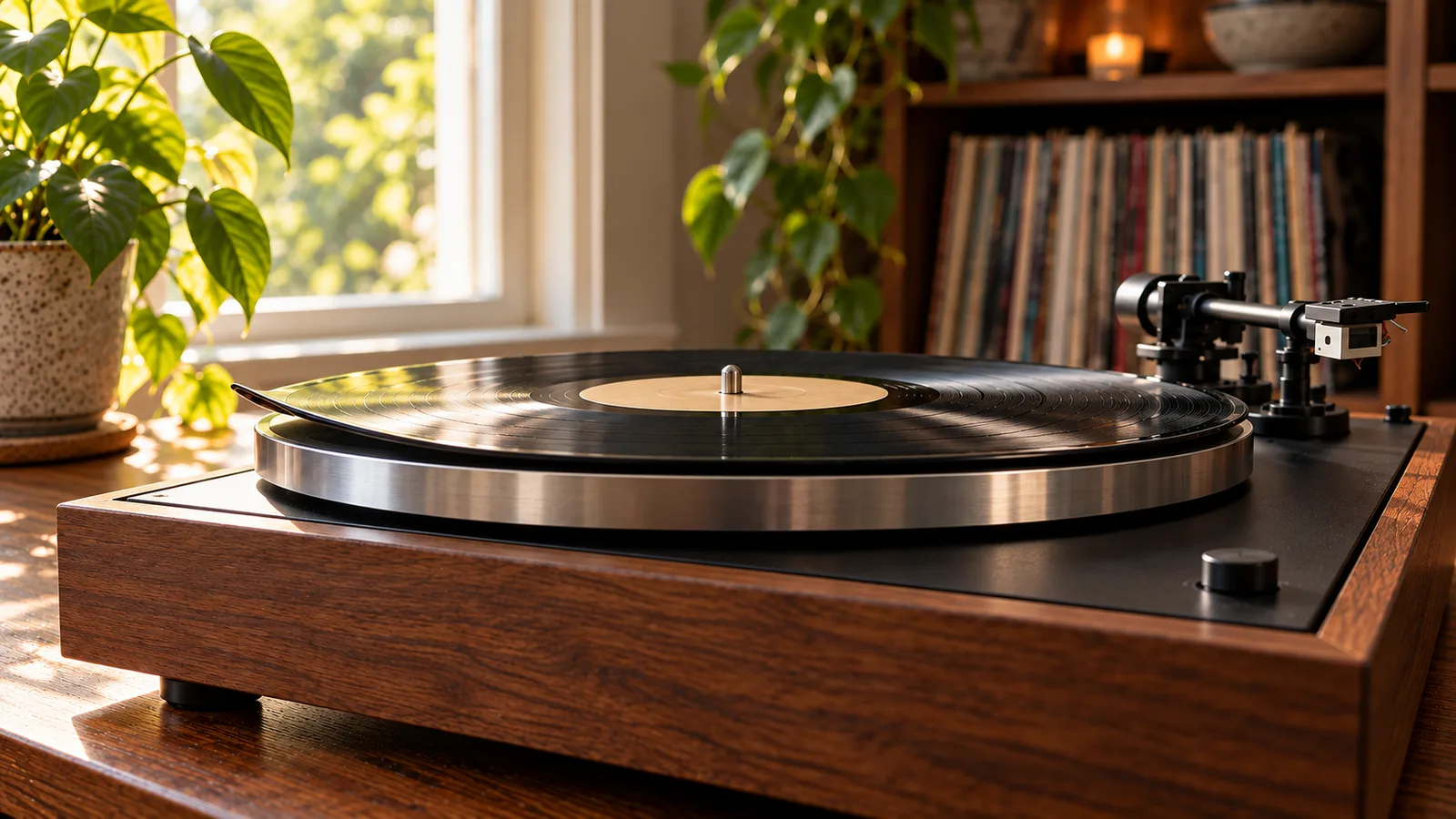
The edge rises as the record turns. The cartridge climbs, drops, then climbs again. Now you have two questions: can you play it, and should you try to flatten it?
Do not start with an oven, sunlight, heavy books, or extra tracking force. A warp is a change in the shape of the disc. Heat and pressure can change it again, but they can also deform the groove you are trying to save.
Start by identifying the warp and watching how your turntable responds. Most collectors need a return decision or a safe-play decision, not a home restoration experiment.
First, make sure the record is actually warped
Put the clean record on a stationary, level platter. Look across it from the side at platter height. Rotate it slowly by hand using the platter edge, without touching the grooves.
A warped disc changes height as it turns. A platter mat that is not seated properly, debris under the record, or a label that is thicker on one side can imitate a small wobble. Remove the record, check the mat and platter, then test again.
Look for the pattern:
- An edge warp lifts part of the outer rim.
- A dish warp makes the record broadly concave or convex, so one side may sit better than the other.
- A local ripple bends a smaller area and can make the stylus move abruptly.
- An off-centre hole moves the tonearm from side to side rather than mainly up and down.
That last distinction matters. A centred record with a warp changes height. An off-centre pressing changes the groove’s distance from the spindle and can make sustained notes waver even when the disc looks flat.
Do the stationary clearance check
Leave the turntable off. Use the cueing lever to lower the stylus onto a flat-looking section near the outer groove, then raise it again. Do not push the tonearm down by hand.
Now position the stylus above the highest part of the warp without lowering it. Check whether the cartridge body, stylus guard, tonearm, or any low part of the deck could strike the record as it rises.
If clearance looks doubtful, stop. Do not use playback to discover whether the cartridge bottoms out.
The US National Archives tells readers not to play a visibly warped grooved recording without preservation guidance. That standard is aimed at archival material, so a replaceable modern LP does not need museum treatment. The warning is still a sensible line for a severe warp, an unfamiliar disc format, or an irreplaceable record.[7]
Run one cautious revolution
For a mild warp with clear cartridge clearance, start the platter with the tonearm still raised. Watch one complete revolution from the side.
Then lower the stylus with the cueing lever at low volume. Keep your hand near the lever for the first turn.
Stop immediately if:
- the cartridge body approaches or touches the record
- the stylus leaves the groove
- the tonearm drops hard after the crest
- the record slips against the platter
- the warp makes the cueing platform or another part interfere with the arm
- you hear a repeated thump, pitch change, or mistracking that makes the record unpleasant to play
Do not add tracking force to pin the cartridge down. The correct tracking force comes from the cartridge specification, not from the shape of one damaged record. The Canadian Conservation Institute advises balancing the tonearm and applying only the tracking force recommended for the cartridge.[3]
A record that technically plays is not automatically acceptable. A new LP with a visible rise, repeated pitch movement, or unstable tracking is defective enough to document and discuss with the seller.
Decide whether to keep, return, or stop
Return a new record when the warp affects use
Photograph the record from platter height while it is stationary. Record a short video of one full revolution with the stylus safely raised. Keep the packaging and contact the seller inside the return window.
Describe what the warp does, not only how it looks. “The outer edge rises and the cartridge body nearly touches once per revolution” is more useful than “very warped.”
Do not try heat, clamps, or heavy books before asking for a replacement. A home treatment can make the condition harder to prove and may remove your cleanest return option.
Keep a mild warp only if playback stays stable
A small cosmetic rise may not affect tracking or pitch. If the cartridge clears it comfortably and the record plays normally, keeping it is a judgement call.
Make that decision while a return is still possible. Play both sides once, inspect the disc under good light, and listen to quiet and sustained passages. Warping can cause speed variation and audible artefacts, according to NEDCC’s guidance for grooved media.[5]
Stop with rare, unique, or unfamiliar discs
Do not treat every black disc as an ordinary vinyl LP. Lacquer discs, shellac records, flexi discs, and other grooved formats respond differently to handling, playback, and heat. NARA notes that grooved recordings vary in chemical composition and warns against playing a disc that appears warped without specialist guidance.[7]
If the recording is unique, unusually valuable, cracked, bubbling, peeling, or covered by a white oily film, stop. Those signs can indicate a more serious material problem than an ordinary warp.[7]
Why the oven-and-glass trick is a bad bet
The internet version sounds tidy: put the record between sheets of glass, add heat, then let it cool flat. The missing part is control.
IASA’s professional procedure calls for a thermostatic laboratory oven, hardened polished glass, careful cleaning, staged heating, and experienced judgement about when the material has softened enough. It explicitly says a domestic oven is not appropriate.[1]
Even controlled flattening has a cost. IASA cites research that found a measurable rise in subsonic and low audible frequencies after heat flattening. It says the evidence was limited, but the risk should still be weighed against the benefit of making an unplayable record playable.[1]
That is the right trade-off. Flattening is restoration, not routine maintenance.
Avoid these improvised methods:
- a kitchen oven
- direct sun between panes of glass
- a hairdryer or heat gun
- boiling water
- piles of books for days or weeks
- bending the disc in the opposite direction
- raising tracking force so the stylus follows the warp
Books may fail to change the disc at all. Heat may change more than the visible bend. Neither method tells you what happened to the groove geometry.
When professional flattening makes sense
Consider a specialist only when all of these are true:
- the record is difficult or unsafe to play as it is
- a replacement is unavailable or unreasonable
- the musical or personal value justifies the risk and cost
- the specialist accepts that specific disc type and pressing
- you understand that improvement is not guaranteed
Ask what equipment the specialist uses, whether the process heats the full groove area, which disc types they refuse, and what happens if the result is worse.
For an irreplaceable recording, preservation may mean making a careful transfer rather than chasing a perfectly flat object. IASA says restoration can make an unplayable disc playable, but the possibility of damage must be weighed against that benefit.[1]
Prevent the next warp
Flattening advice gets attention. Storage prevents more damage.
Store records vertically in their sleeves, with full-height support and no long leaning run. Do not stack LPs horizontally. NARA, the Library of Congress, and the Canadian Conservation Institute all give the same basic direction for grooved discs.[2][3][6]
Keep the shelf away from radiators, direct sun, hot lofts, garages, and other places with large temperature changes. NARA recommends a stable environment and specifically warns against unregulated attics and garages.[6]
Remove tight shrink wrap from the jacket. The Canadian Conservation Institute warns that shrink wrap can keep contracting and warp the record.[3]
Support matters too. The Library of Congress recommends sturdy dividers every four to six inches that support the full face of a sleeved disc.[2] A half-empty cube with thirty records leaning at an angle is not harmless long-term storage.
If heat or storage caused the problem, fix that before returning the record to the shelf. Otherwise, a successful replacement can meet the same fate.
Use this warp checklist
- Check the platter, mat, and label before blaming the disc.
- View the stationary record from platter height.
- Identify edge lift, dish, local ripple, or side-to-side off-centre movement.
- Check cartridge clearance with the platter stopped.
- Watch one revolution with the stylus raised.
- Play cautiously at low volume only if clearance is safe.
- Stop for contact, mistracking, slipping, or an abrupt tonearm drop.
- Keep tracking force at the cartridge’s specified value.[3]
- Document a new defect before attempting any treatment.
- Return a replaceable bad copy. Take an important or unfamiliar disc to a specialist.
The bottom line
A warp does not need an immediate cure. It needs a calm assessment.
Check that the disc, not the mat or platter, is moving. Confirm clearance. Watch one revolution before lowering the stylus. If a new record cannot track safely or play steadily, document it and use the return window.
Save flattening for records that cannot simply be replaced. Professional heat treatment still carries risk. A kitchen experiment carries more, with none of the control.
Sources
[1] https://www.iasa-web.org/tc04/microgroove-cleaning-and-carrier-restoration — IASA TC-04: Microgroove cleaning and carrier restoration [2] https://www.loc.gov/preservation/care/record.html — Library of Congress: Care, handling, and storage of audiovisual materials [3] https://www.canada.ca/en/conservation-institute/services/care-objects/electronic-media/video-audio-recordings-8mm-films-faq.html — Canadian Conservation Institute: Video and audio recordings FAQ [5] https://www.nedcc.org/fundamentals-of-av-preservation-textbook/chapter1-care-and-handling-of-audiovisual-collections/chapter-1-section-2 — NEDCC Fundamentals of AV Preservation: Grooved media [6] https://www.archives.gov/preservation/formats/audio-storage.html — US National Archives: Audio storage guidance [7] https://www.archives.gov/preservation/holdings-maintenance/machine-readable — US National Archives: Grooved sound recordings