Here’s a frustrating truth: you can spend thousands on a turntable and speakers, only to have your room undermine the whole thing. Sound bounces off walls, bass builds up in corners, reflections smear the stereo image. Your equipment might be capable of beautiful reproduction—but your room is getting in the way.
The good news? You don’t need an acoustically designed studio to hear your records properly. Some basic adjustments—many of them free—can transform how your vinyl sounds.
Why the Room Matters So Much
Sound doesn’t just travel in a straight line from your speakers to your ears. It bounces off every surface: walls, ceiling, floor, furniture, windows. Some frequencies build up where they shouldn’t. Others cancel out and disappear. Reflections arrive at your ears milliseconds after the direct sound, blurring detail.
In untreated rooms, you’re not hearing your stereo—you’re hearing your stereo plus your room’s opinion about your stereo. And often, that opinion isn’t great.
Start With Placement (It’s Free)
Before buying anything, optimize what you have.
The Stereo Triangle
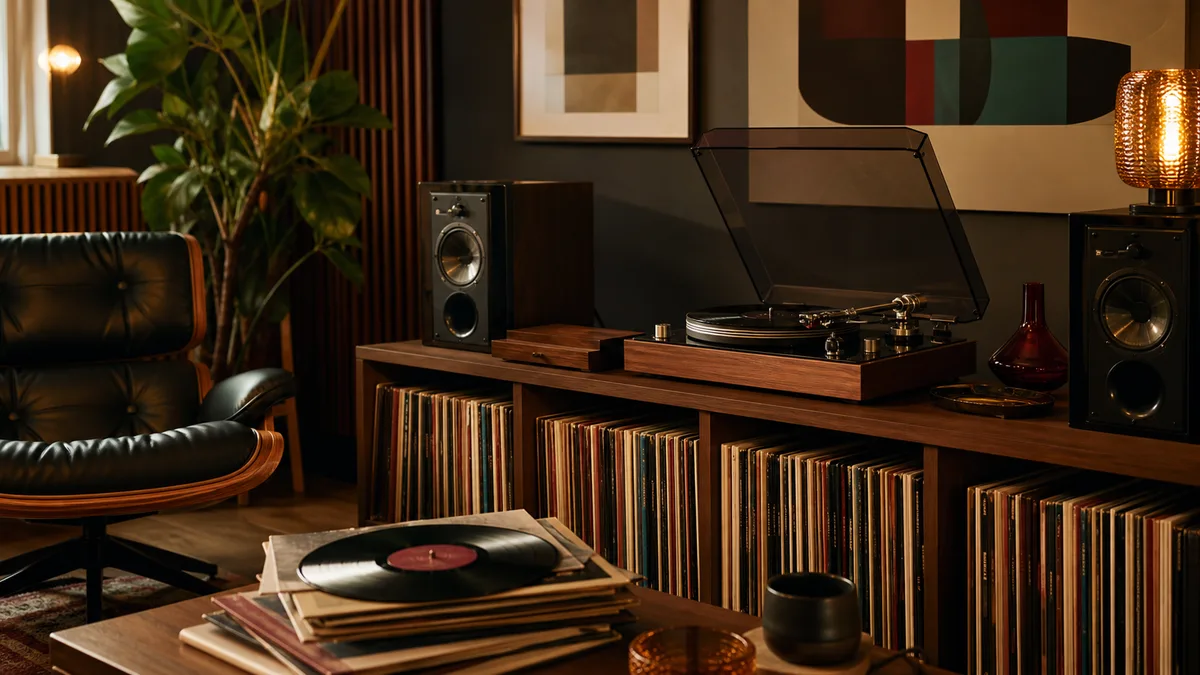
Picture an equilateral triangle: your two speakers and your listening position are the three corners. The distance between speakers should roughly equal the distance from each speaker to your head. Point the speakers toward your ears, not straight ahead.
This creates the “sweet spot” where stereo imaging actually works—where you can close your eyes and sense instrument placement in the soundstage.
Pull Speakers Away From Walls
Speakers placed right against walls produce boomy, undefined bass. The wall becomes part of the speaker’s output, reinforcing low frequencies excessively. Pull them out at least a foot or two if you can.
Corners are even worse. Corner placement massively amplifies bass frequencies and muddies everything up. Avoid it unless you want your living room to sound like a subwoofer demonstration gone wrong.
Your Seat Matters Too
Don’t push your couch against the back wall. Bass builds up at boundaries, creating uneven response. Pull your listening position forward by a few feet if possible.
Center yourself between the side walls. Even small asymmetries affect stereo balance—if you’re closer to one wall than the other, one speaker will sound louder.
A useful starting point: sit about 38% of the room’s length from the front wall. This often avoids the worst spots for room resonances.
The Mirror Trick
This one’s genuinely useful. Sit in your listening position and have someone hold a mirror flat against the side wall. Slide it along the wall. Every spot where you can see one of your speakers in the mirror is a “first reflection point”—a place where sound bounces from speaker to your ear.
These reflections are the biggest problem in most rooms. They arrive slightly after the direct sound and mess with clarity and imaging.
Mark those spots. If you’re going to treat anything acoustically, treat those first.
Acoustic Treatment (When You’re Ready)
Absorption Panels
These are fabric-wrapped fiberglass or rockwool panels that absorb mid and high frequencies. Put them at first reflection points—the spots you found with the mirror trick—and you’ll notice improved clarity and imaging almost immediately.
You can buy commercial panels or make your own. DIY is cheaper and surprisingly easy: rigid fiberglass insulation, a simple wood frame, and acoustically transparent fabric wrapped around it. There are guides everywhere online.
Bass Traps
Low frequencies are harder to control. They build up in corners, creating that boomy undefined sound that obscures everything else.
Bass traps are thick absorptive materials placed in corners—ideally floor to ceiling in the vertical corners, and in the wall-ceiling corners if possible. Regular acoustic foam isn’t thick enough to absorb bass; you need dense fiberglass, rockwool, or purpose-built bass trap products.
Diffusers
While absorbers remove reflections, diffusers scatter them in multiple directions. This keeps some sense of room liveliness while preventing harsh echoes.
Diffusers work best on the wall behind your listening position, or sometimes behind the speakers. They need distance to be effective, so small rooms may not benefit much.
How Much Treatment?
A good target is treating about 22-25% of your room’s surface area. That includes panels, bass traps, diffusers, and soft furnishings that naturally absorb sound.
Don’t overdo it. Too much absorption creates a “dead” room that sounds unnatural and fatiguing. You want controlled reflections, not silence.
Budget-Friendly Fixes
Professional acoustic panels work great but cost money. These alternatives help on a budget:
Heavy curtains over windows absorb reflections. Thick velvet or heavy linen works best. Draw them when you’re listening seriously.
Bookshelves full of randomly sized books act as natural diffusers. Put one behind your listening position if you can.
A thick rug between you and the speakers reduces floor reflections. Especially important if you have hard flooring.
Soft furniture—couches, upholstered chairs, throw pillows—all absorb sound. A furnished room sounds better than an empty one almost by definition.
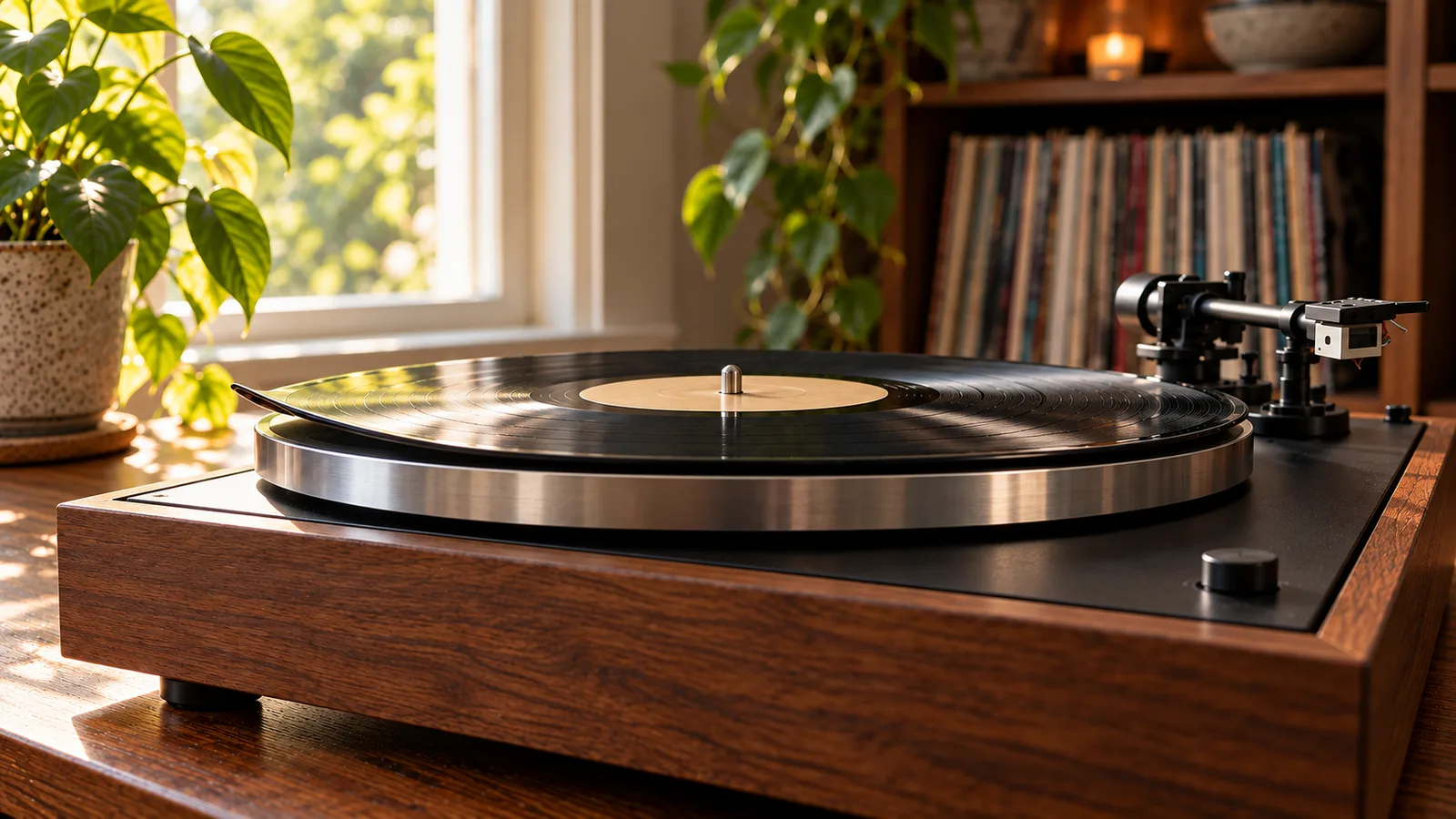
Turntable Placement
Your turntable has specific needs beyond acoustics:
Isolation from vibration. Keep it away from speakers—bass travels through the floor and gets picked up by the cartridge. Use a solid, heavy stand that resists vibration. Consider a wall-mounted shelf if floor vibration is severe (like in older buildings).
Level surface. Use a bubble level to ensure the platter is perfectly horizontal. Even small tilts affect tracking and sound.
Distance from subwoofers. If you run a sub, put it as far from the turntable as possible. Low frequencies can feed back through the stylus.
The Clap Test
Here’s a quick way to assess your room: stand in your listening position and clap your hands once, loudly. Listen to the decay.
If you hear a quick, crisp decay, your room is reasonably controlled.
If you hear a lingering ring or flutter echo, you’ve got too much reflection happening. That’s what treatment addresses.
Start Simple, Upgrade Gradually
You don’t need to do everything at once:
First: Optimize speaker and seating placement. This is free and often makes the biggest difference.
Second: Add a rug and heavy curtains if you don’t have them. Inexpensive and effective.
Third: Treat first reflection points on your side walls and ceiling. This is where absorption panels provide the most bang for the buck.
Fourth: Add bass traps in corners if boomy bass is a problem.
Fifth: Consider diffusion behind your listening position once everything else is sorted.
Each step brings audible improvement. Stop when you’re happy.
The Payoff
A well-set-up room reveals details you didn’t know were in your records. The bass tightens up. Instruments separate in the soundstage. Vocals become more present. The whole experience becomes more immersive.
Your vinyl has always had this information in the grooves. Your room was just getting in the way of hearing it.
Give your records the environment they deserve, and they’ll reward you with music you didn’t know they contained.
Sources: Audio Keeper, GIK Acoustics, Audioengine, Bang & Olufsen