The summer of 2025 was grim in a lot of places. Phoenix hit 115°F for the fifth consecutive year. Athens recorded its highest-ever temperatures. Parts of Southern Europe went weeks without meaningful rainfall. In the UK, the summer wasn’t dramatic by Mediterranean standards, but the writing is on the wall.
For vinyl collectors, this isn’t just an abstract environmental concern. It’s a practical one. Records are PVC. PVC responds to heat. And if you’re not thinking about where your collection lives as the climate shifts, you’re taking a risk that’s entirely preventable.
What Heat Actually Does to Records
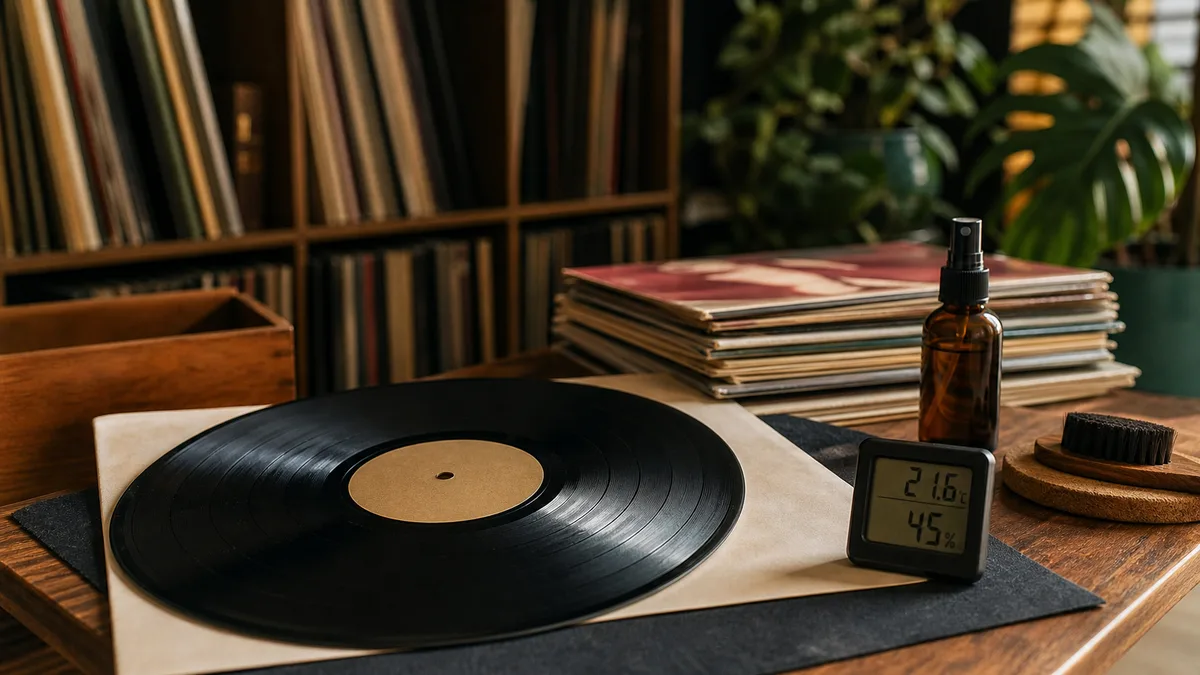
Vinyl’s comfort zone is roughly 65-75°F (18-24°C) and 40-50% relative humidity. Most of the time, most homes stay in that range. The problems start when they don’t.
Above 80°F, you’re in the territory where things start to go wrong slowly. The vinyl softens. Warping becomes possible — not instant, but more likely the longer exposure continues. Above 90°F, the risk rises sharply. And it’s not just ambient temperature: direct sunlight on a record can cause warping in minutes, even if the room is otherwise fine. Leave a record on a sunlit table for an afternoon and you might have a problem you’ll never fix.
The other enemy is humidity. Below 40% relative humidity, static becomes a serious issue — paper sleeves tear, dust clings, surface noise increases with every play. Above 70%, mold becomes a genuine threat. Paper sleeves get fuzzy. Labels deteriorate. The musty smell that collectors dread is the smell of mold that’s been living off your sleeves for months.
These thresholds aren’t arbitrary. They’re the thresholds that separate a record you’ll be able to play in 20 years from one you’ll be trying to give away on Facebook Marketplace because it sounds rough.
What a Warming Climate Changes
Here’s the uncomfortable part: the extremes are getting more extreme, and they’re lasting longer.
In 2023, scientists recorded the first individual day where global average temperature exceeded 2°C above pre-industrial levels. In 2024 and 2025, heat records continued to fall with depressing regularity. The baseline is shifting, which means the “once in a decade” heatwave is becoming a “once every few years” event.
For collectors, this matters in a few concrete ways:
Your storage room that used to be safe in summer might not be anymore. A room that stayed below 80°F during a normal July in 2015 might regularly hit 85°F during the summers of 2025 or 2026. If that room is your attic or a poorly insulated spare bedroom, your records have been living through increasingly stressful summers without you noticing.
Hot cars are even more dangerous than you think. Interior car temperatures can hit 140°F on a hot day, even with windows cracked. This is well above the threshold for vinyl damage. Leaving records in a car “for just a minute” has always been foolish. It’s getting foolisher as average temperatures rise.
Fans and air conditioning change the equation. If you’re running AC to stay comfortable, you’re probably also keeping your records at a survivable temperature. The issue is people who don’t have AC — or who keep records in parts of the house that don’t get cooled. In Southern Europe, Australia, and parts of the US, this is a significant and growing concern.
Humidity spikes are harder to predict. Climate change doesn’t just mean hotter — it means more variable. Extended dry periods followed by sudden humidity are as damaging as sustained heat, because the vinyl and sleeves expand and contract with changes in moisture content.
What Collectors in Hot Climates Should Do Differently
If you live in a genuinely hot climate — Southern Europe, the American South, Australia, anywhere with regular summer temperatures above 85°F — the standard “room temperature is fine” advice needs to be taken more seriously than it might be in northern Europe.
The practical steps are:
Move records out of problem rooms. Attics are almost always bad. Garages are almost always bad. Basements can be damp. If your records are in any of these, get them into climate-controlled living space.
Invest in a dehumidifier if humidity is your problem. In coastal areas or during humid summers, a basic dehumidifier in a storage room can make the difference between a collection that lasts and one that slowly degrades. They’re not expensive.
Use silica gel packs in enclosed storage. Even in a room that’s broadly okay, a box of records in a cupboard can develop localized humidity issues. A few silica gel packs in storage boxes absorb moisture and smooth out the peaks.
Never leave records in a car. This was always true. It’s more true now.
Consider climate-controlled storage for significant collections. If your collection has real monetary or sentimental value, and you live somewhere with serious summer heat, a climate-controlled storage unit is worth the cost. It’s not overcautious — it’s proportionate.
Vinyl vs. Other Formats in a Climate-Changed World
Is vinyl the most climate-resilient music format? No. That award probably goes to digital files, which exist at room temperature indefinitely with no degradation — assuming the storage infrastructure survives. CDs are reasonably stable if kept away from heat and light, but they’re more vulnerable to humidity than vinyl in some ways and less vulnerable in others.
Vinyl’s advantage is durability if properly stored: a record in a good sleeve, standing upright in a climate-controlled space, will outlast almost any digital storage system. Streaming depends on server farms, power infrastructure, and company continuity — none of which are guaranteed over 50 years. A well-kept record from 1975 still plays. Good luck finding a functioning device to read a Minidisc in 50 years.
The honest comparison is this: vinyl is fragile in ways that streaming isn’t, and streaming is fragile in ways that vinyl isn’t. A fire destroys your records. A data center outage makes your streaming library temporarily inaccessible. A heatwave warps your vinyl collection. A company shutting down wipes your uploaded library.
None of these formats is inherently “safer.” They have different failure modes. Understanding which one you’re optimizing for matters.
The Bottom Line
Climate change doesn’t mean your records are doomed. It means the conditions you’ve been assuming were fine might need a second look.
Most collectors in temperate climates — the UK, northern Europe, the Pacific Northwest — are probably okay. Their homes naturally stay in or near the safe range for vinyl storage. A few hot days a year won’t cause catastrophic damage.
But if you’re in a hot climate, or if you’ve noticed your storage space getting warmer in summer than it used to, the time to act is now. A warped record doesn’t recover. A moldy sleeve doesn’t unwilt. Prevention is the only option that works.
Records are objects. They respond to their environment. In a world where that environment is getting less predictable, paying attention to where your collection lives isn’t neurotic. It’s just maintenance.
Sources: Keep Them Spinning: Vinyl Record Storage Guide 2026, SpareFoot: Vinyl Storage Guide, 10 Federal Storage: How to Store Vinyl Records, Throwbacks: Restore Vintage Vinyl Collection