There’s a reasonable amount of content out there about cleaning vinyl records. How to do it, what solutions work, how often to do it, ultrasonic cleaners versus manual cleaning. All of that is useful.
What’s less well covered is the stuff that damages records over time without looking particularly dramatic — the slow threats, the things that happen while the record is sitting in its sleeve, the mistakes that don’t show up until months or years later.
Here are the ones worth taking seriously.
Heat Damage: The Slow Warp
Heat is the most consistent long-term threat to vinyl, and it operates below the threshold most people would notice in daily life.
Standard PVC records can begin to soften and warp at temperatures around 140°F (60°C). That’s well above normal room temperature — you won’t hit it just from having records in a flat. But cars left in direct sunlight, records stored near radiators, or collections kept in rooms that get genuinely hot (attics, south-facing rooms in summer) can get closer to that range than you’d expect.
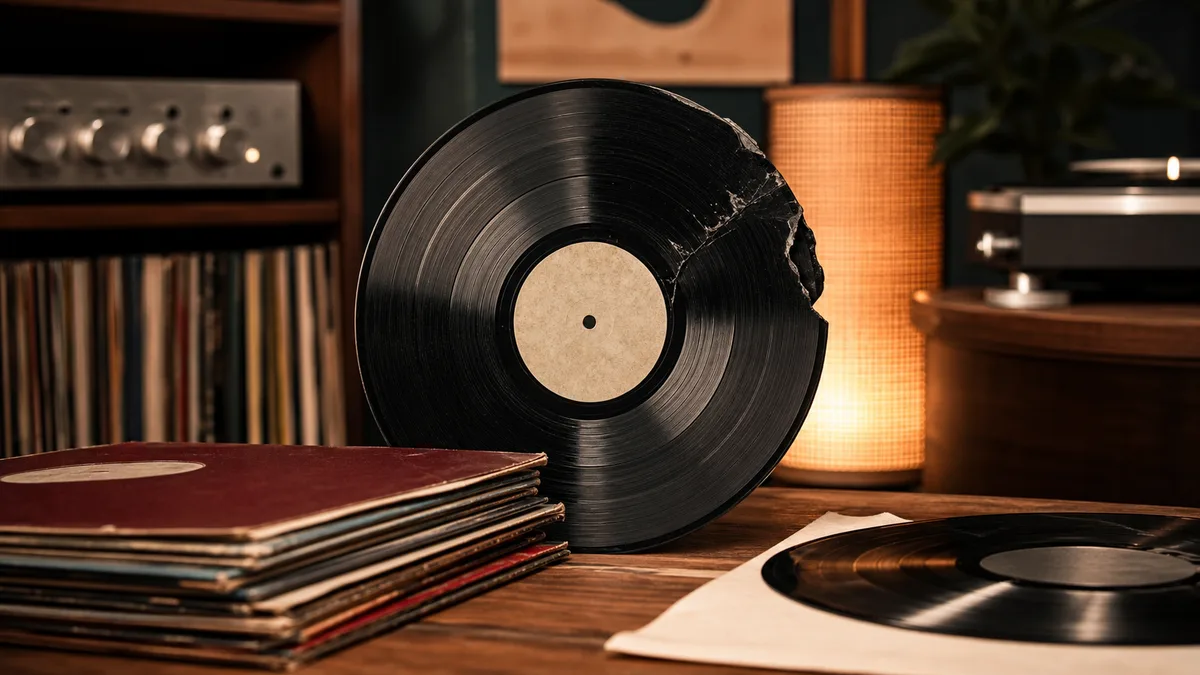
The problem with heat damage is that it’s cumulative and partially irreversible. A record that softens and cools back into shape doesn’t return fully to its original geometry. The warp may be subtle enough that it doesn’t cause obvious skipping, but it will introduce tracking distortion — the needle doesn’t sit in the groove correctly, and the inner grooves take the most stress.
Ideal storage temperature for vinyl is roughly 65°F to 70°F (18°C to 21°C). Above 80°F (27°C) sustained, you’re moving into real risk territory.
Humidity and Mold: The Invisible Invasion
High humidity doesn’t warp records directly — that needs heat. What it does is create conditions for mold growth on both the record surface and the paper inner sleeves that come with most new pressings.
Mold on the record surface creates a pattern of small, irregular marks that a stylus encounters as noise and intermittent distortion. It can work its way into the grooves permanently. Mold on paper sleeves is less immediately damaging to the vinyl but degrades the sleeve itself and can transfer marking to the vinyl label.
Humidity above roughly 60% is where mold becomes a genuine risk. Below 30%, static electricity increases, which attracts dust. The ideal range is usually cited as 40-50% relative humidity.
Basements and attics are the worst places for vinyl storage in most climates — both tend to have uncontrolled humidity fluctuations. A spare room with central heating is usually fine. A converted cellar in an old UK house needs more attention.
UV Exposure: Fading and Embrittlement
Sunlight through a window is enough to cause long-term damage to vinyl, though it works more on the packaging and labels than the record itself.
UV radiation causes the PVC to slowly oxidise and embrittle at the surface. On coloured vinyl particularly, direct sunlight can cause fading. The more immediate risk is to paper components — covers, sleeves, and especially labels — which fade, yellow, and become brittle under sustained UV exposure.
Keep records out of direct sunlight. Even a few weeks of a record left in a sunny spot can cause visible fading on sleeve artwork.
Seam Splits and Ring Wear: The Handling Damage
Two of the most common forms of physical damage that happen over a record’s life:
Seam splits occur when the adhesive holding a record cover together degrades, typically along the spine. This is hastened by records stored flat or under pressure, which puts stress on the seams. Storing records vertically, without leaning, reduces this significantly.
Ring wear — that characteristic grey marking on the record cover where it sits against the underside of the lid — comes from covers resting against each other under pressure, or from covers that have been stored flat. It’s mostly cosmetic on the sleeve, but it’s also a sign that the cover has been under sustained pressure, which means the records themselves probably were too.
Neither of these affects playback directly, but they affect value. A NM (near mint) sleeve with a seam split is worth considerably less than one that’s intact.
Off-Center Holes and Warping from Stacking
This one is less obvious.
Off-center pressings — where the spindle hole isn’t quite centred — are usually a manufacturing defect. They cause the stylus to track unevenly across the groove walls, which increases wear on both the record and the stylus. If you have records that consistently track badly on one side despite cleaning, check the hole.
Warpage from stacking is a slow process. When records are stored flat, especially without support at the edges, the weight of records above them creates a subtle bow in the lower records. Over months, this becomes permanent. Storing records vertically — not leaning, not pressed tight — is the straightforward solution.
What “Sealed” Doesn’t Mean
A word on sealed records, because this comes up a lot in collecting.
Sealed doesn’t mean undamaged. Records sealed in hot conditions — a warehouse, a car, a shop window — may have been exposed to heat before being sealed. Records that have been sealed for years in imperfect conditions may have humidity damage that’s hidden inside the sleeve. Sealed coloured vinyl can have colour migration issues that only become apparent when opened.
For most collecting purposes, a record that’s been opened and stored carefully is better than a record that’s been sealed in poor conditions. Don’t pay a significant premium for sealed without asking about the storage history.
The Practical Checklist
A few things that make a real difference without much effort:
- Store records vertically, not flat, not leaning
- Use outer sleeves — they don’t prevent seam splits but they slow them down
- Replace cheap paper inner sleeves with archival polyethylene or rice paper sleeves
- Keep storage temperature between roughly 18°C and 21°C
- Keep relative humidity between 40% and 50%
- Never leave records in a car, even briefly on a warm day
- Don’t store records in lofts or basements unless you control the environment
- Handle by the edges, not the playing surface
- Open resealable sleeves carefully to avoid cutting into the sleeve edge
None of this is complicated. Most of it is just making a small number of consistent habits around storage and handling. The records you’re buying today will be in much better shape in ten years if you follow them.
Sources: Groove Guardian: How Temperature and Humidity Impact Your Vinyl Collection, Routine Vinyl: 7 Tips to Prevent Vinyl Warping, Peak Vinyl: At What Temperature Does Vinyl Records Warp?, Vinyl.com: How to Properly Store Your Vinyl Collection to Avoid Damage, Sumikono Cartridges: Storing Records Everything You Need to Know