Buying records is easy to turn into a habit. Listening to the records you already own takes a little more intention.
That is not a moral failure. Most collectors have shelves that grew faster than their listening time. New arrivals sit near the turntable. Old favourites get played again. A few expensive or sentimental records become almost too special to touch. Somewhere in the middle are dozens of albums you meant to revisit and never quite did.
National Album Day is built around a simple idea: the album is still worth hearing as a whole work, not just as a background stream or a single track in a playlist. For vinyl collectors, that is a useful prompt. Instead of asking what to buy next, ask what your own shelves are already asking you to play.
Here is a practical way to build a listening queue from the records you already own.
Start With a Small Queue, Not the Whole Collection
Do not begin by trying to rank every album you own.
That turns a listening habit into admin. Start with a queue of 10 to 20 records. Big enough to give you choice, small enough that it still feels like music.
A good first queue might include:
- three records you have never played properly
- three old favourites you have not heard this year
- three recent buys
- three albums connected to a theme
- one record you keep avoiding
- one record you might sell if it does not land anymore
That mix gives the queue a job. It is not just “records I like.” It becomes a way to rediscover, test, compare, and make better decisions about the collection.
If 20 records feels too many, start with five. The point is movement.
Make Four Listening Buckets
Most collection queues work better when they are split by purpose.
Recent arrivals are the records you bought, cleaned, cataloged, and then somehow did not play. Every collector knows this pile. It deserves a queue because the excitement of buying can fade before the album gets a fair listen.
Neglected records are albums that have been sitting quietly for months or years. Some will remind you why you bought them. Some will reveal that your taste has moved on. Both outcomes are useful.
Reliable favourites are the records that make the queue feel inviting. A rediscovery system made entirely from homework records will collapse quickly. Put comfort albums in there too.
Decision records are the ones with a question attached. Keep, sell, trade, upgrade, clean, re-sleeve, rebuy, or finally admit you only liked the idea of owning it.
Those buckets keep the queue balanced. You are not only chasing novelty, and you are not only forcing yourself through neglected albums like chores.
Pick a Theme When You Feel Stuck
If choosing records feels weirdly difficult, use a theme.
Themes make the first decision for you:
- albums released in the same year
- one label or scene
- records bought from the same shop
- artists you discovered through another artist
- albums with great side B openers
- records you own on vinyl but rarely stream
- albums you bought during a specific trip or phase
- records by artists connected to the National Album Day theme
The theme does not need to be clever. It just needs to get you from a wall of spines to a small pile.
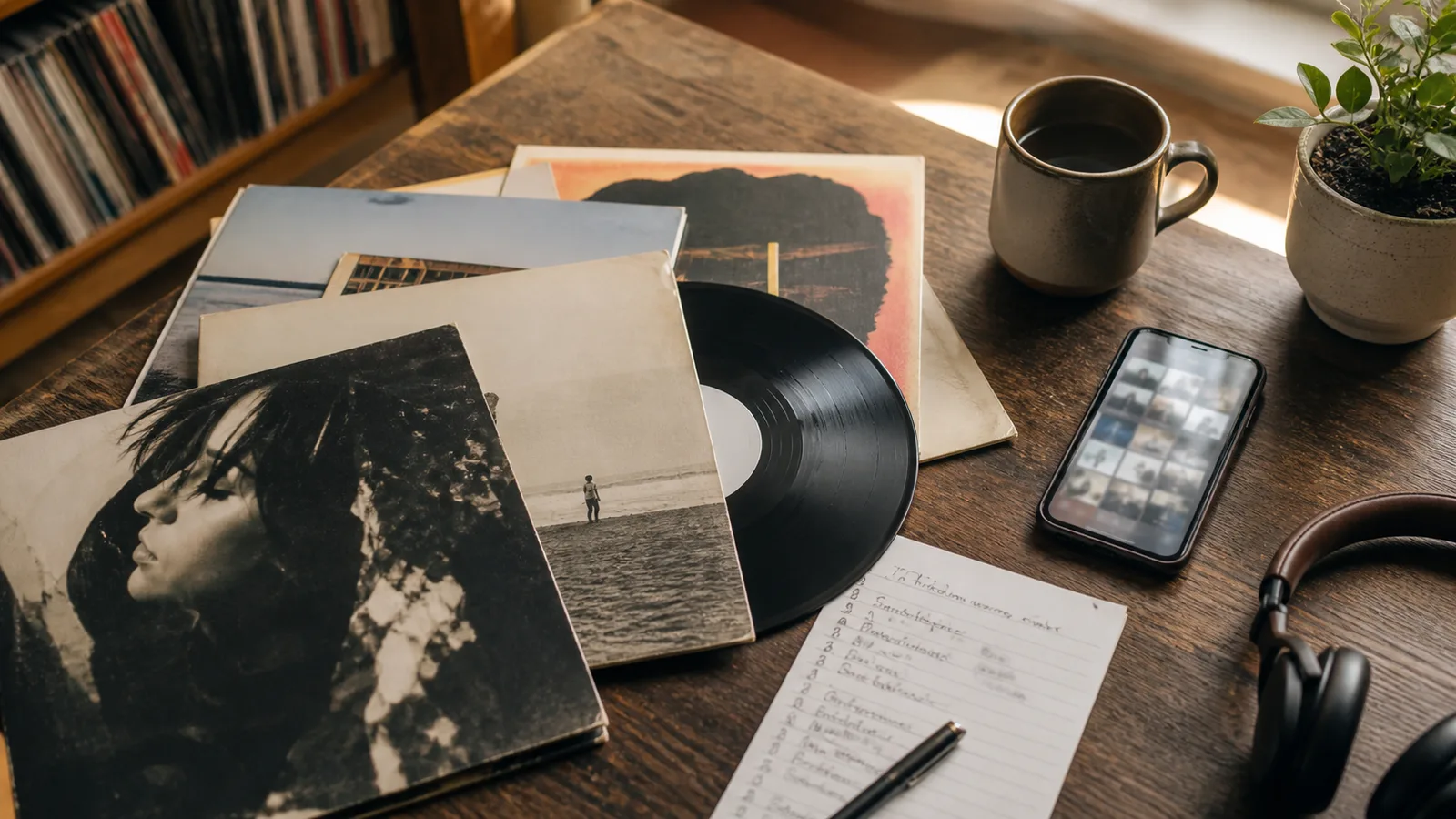
This is where a catalog helps. In My Vinyl+, you can browse your collection away from the shelf, check years, artists, genres, values, notes, and Discogs-linked release details, then decide what deserves a spot before you start pulling records out.
Add a Reason to Each Record
A listening queue is more useful when every record has a reason.
Not a review. Just a short note.
Examples:
- “First full listen since buying”
- “Check if this copy needs cleaning”
- “Still want the deluxe reissue?”
- “Compare with the 2018 repress”
- “Play before deciding whether to sell”
- “Sunday morning record”
- “National Album Day icons theme”
- “Bought for one track, listen to the full album”
That tiny reason changes the session. You are no longer dropping the needle at random. You know what you are listening for.
It also helps later. If an album felt flat, was it the music, the pressing, the condition, or the mood? A note gives future you something more useful than a vague memory.
Listen in Album-Sized Blocks
Vinyl is good at making you commit, but it is still easy to turn records into fragments.
You play side A while cooking. You skip the quiet track. You get distracted before side B. None of that is wrong, but if the goal is album listening, give the record one clean pass.
Try this:
- one album with no phone scrolling
- both sides before switching records
- volume set properly, not as background murmur
- sleeve and notes nearby
- one quick note afterward
That is enough. You do not need a formal rating system unless you enjoy one.
The important part is hearing the album as an album. Track order, side breaks, pacing, sequencing, artwork, and the physical ritual all matter. National Album Day exists because those things still mean something.
Use the Queue to Improve the Collection
The best listening queue does not only produce listening time. It improves the collection.
After each record, make one small decision:
- keep in regular rotation
- clean before the next play
- replace inner sleeve
- update condition notes
- add to sell or trade pile
- add an upgrade target to your wantlist
- move it nearer the turntable
- file it back with more confidence
This is especially useful for records you have been unsure about. A record that never gets played because it is too noisy might not need to stay in limbo. Clean it, downgrade the condition, look for a better copy, or let it go.
A record that surprises you can move the other way. Put it into regular rotation. Add a note. Build a mini queue around related artists, labels, or years.
Listening becomes feedback, not just consumption.
Keep a “Why Did I Buy This?” Slot
Every queue should have one wild-card record.
The album you do not remember buying. The sealed record from a sale bin. The variant you ordered during a late-night preorder spiral. The record that looks great on the shelf but never makes it to the platter.
This slot is not about guilt. It is about honesty.
Sometimes the answer is lovely: you bought it because it caught a moment in your life, and it still works. Sometimes the answer is obvious: you bought it because it was cheap, scarce, hyped, or adjacent to something you actually loved.
Either way, you learn something about your collecting habits.
That is valuable. A collection gets better when you understand why records enter it, not just when you track what is already there.
Build a Repeatable Habit
The queue should be easy enough to repeat.
Once a month, choose 10 records:
- two recent arrivals
- two neglected records
- two favourites
- two decision records
- one themed record
- one wild card
Put them in a physical crate, a shelf section, a folder, or a note in your collection app. When you want to play something, choose from that pool first.
At the end of the month, clear the queue. Keep what worked. Move unresolved records into next month only if they still have a reason. Do not let the queue become another permanent pile.
Small rotation beats grand ambition. Ten albums a month is 120 intentional album listens a year. For many collectors, that would transform how alive the collection feels.
The Bottom Line
Your next great vinyl session might already be on your shelf.
Build a small queue. Mix recent arrivals, neglected albums, reliable favourites, decision records, and one strange wild card. Give each record a reason. Listen in album-sized blocks. Let the result change how you catalog, clean, file, sell, trade, or rediscover your records.
National Album Day is a good excuse to start, but the habit is bigger than one date. A collection is not only something you own. It is something you return to.
And sometimes the best record to buy next is no record at all. It is the one you forgot you already had.
Sources: National Album Day: About, Discogs: How Do I Use The Collection Feature?, Discogs: How Do I Use The Wantlist Feature?, My Vinyl+ collection workflow context.