Most record collections become valuable quietly.
You do not wake up one morning and decide to own an insurable collection. You buy a few originals, keep the limited pressing, upgrade a favourite album, grab an import, and hold on to records that would be hard to replace. Then one day the shelf is worth more than your turntable, your speakers, and maybe a lot of the furniture around it.
That is the moment to get boring in the best possible way.
If the collection was stolen, damaged in a flood, lost in a move, or inherited by someone else, could you prove what was there? Could you show condition, pressing details, receipts, and a realistic value? Or would you be trying to rebuild the evidence from memory while stressed?
Insurance is not only about buying a policy. It is about keeping proof.
Start With Your Current Policy
Before making a spreadsheet or photographing every sleeve, read the contents insurance you already have.
Look for:
- total contents cover
- single-item limits
- limits for collections or valuables
- exclusions for collectibles
- accidental damage cover
- theft requirements
- flood and water damage cover
- cover for records away from home
- cover during moving or storage
- whether values are replacement cost or current market value
This is where many collectors find the gap. A normal home policy may cover personal possessions, but it may also have an upper limit for a single item, require extra cover for valuable items, or treat some collections differently from ordinary household goods.
Citizens Advice notes that contents insurance can cover loss, theft, and damage to personal possessions, but it also warns that you may need extra cover for possessions taken outside the home or for a particularly valuable item. It also points out that policies differ on “new for old” replacement versus current value.
Do not assume the word “contents” automatically means “my rare records are covered properly.” Ask the insurer what they need from you before a claim exists.
Decide Which Records Need Extra Evidence
You do not need the same documentation for every record.
A common used LP with no special value can live happily in your normal catalog. The work starts with records that would be hard to replace or hard to prove.
Prioritize:
- records worth more than your policy’s single-item limit
- signed records
- numbered editions
- first pressings
- test pressings and promos
- expensive imports
- rare variants
- sealed records
- box sets
- records with important inserts, posters, booklets, or obi strips
- records bought from private sellers with limited receipts
- records whose value depends heavily on condition
Make a short “insurance priority” folder or tag. The point is not to turn the whole hobby into admin. The point is to know which records need sharper proof than a line in a list.
Record the Exact Pressing
For insurance, “I owned a copy of this album” is weaker than “I owned this pressing in this condition.”
Save:
- artist and title
- label
- catalog number
- barcode if present
- country
- year
- format and colour
- matrix or runout notes for valuable copies
- edition notes
- Discogs release URL or release ID
- sleeve condition
- media condition
- missing or included extras
Discogs sales history is useful because it is tied to specific releases, not only album names. Discogs says its sales history shows the last 30 prices for a sold item, with lowest, median, and highest values calculated from those recent sales. That is a helpful reference point, but it is still only a reference point. Condition, completeness, seller location, timing, and demand all matter.
My Vinyl+ helps here because it gives you a portable record of the exact edition, condition, value, and notes. Use it as the living catalog, then add extra proof for the records that would need a stronger claim file.
Photograph Like You Are Explaining the Record to a Stranger
Insurance evidence should make sense to someone who does not know your shelves.
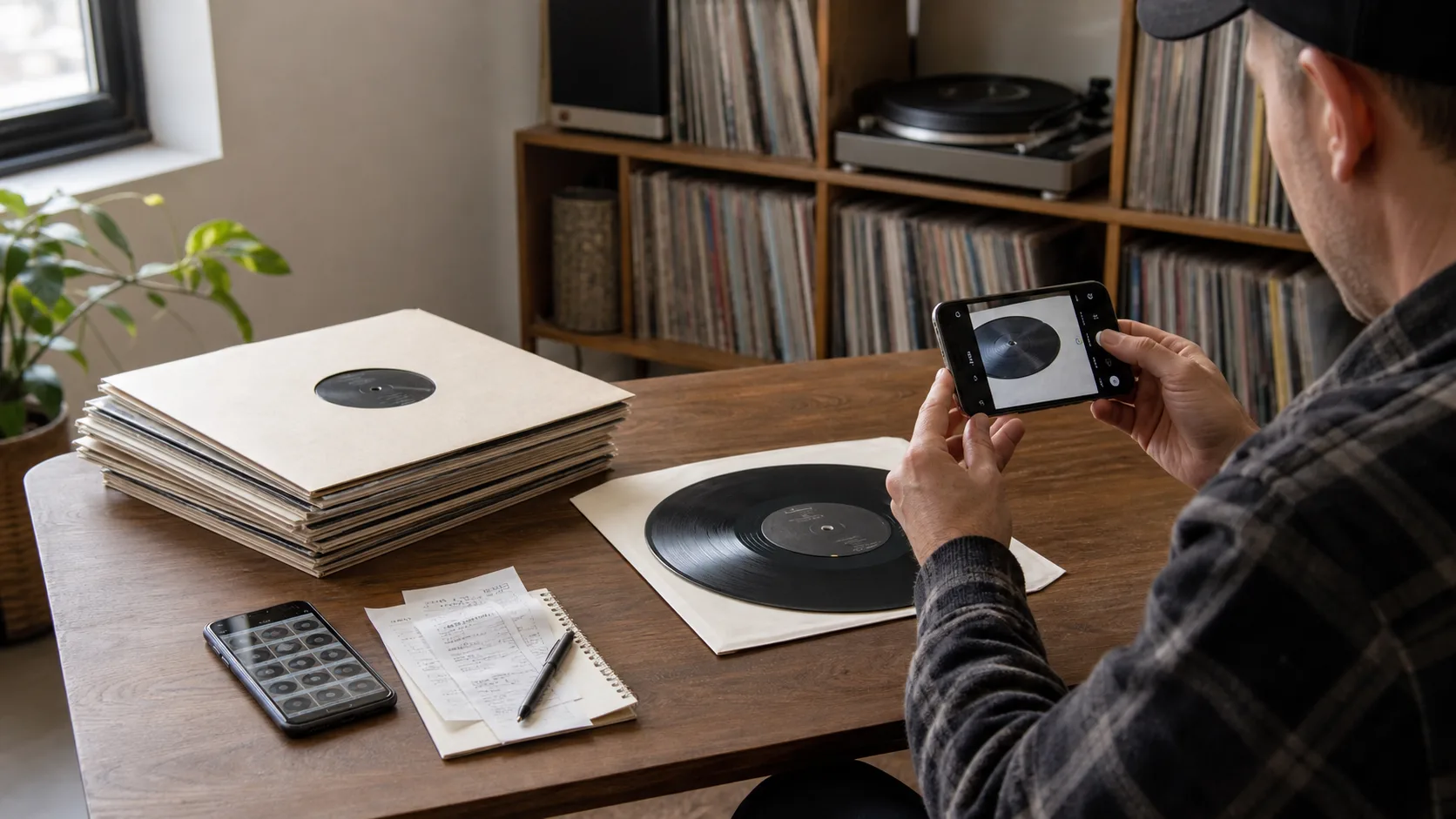
For valuable records, take clear photos of:
- front cover
- back cover
- spine if readable
- labels on both sides
- matrix or runout area if it identifies the pressing
- inserts, booklets, posters, obi strips, stickers, certificates, or signatures
- numbered details
- visible damage or wear
- the record on its own, handled safely by the edges
Use natural light or a desk lamp. Avoid heavy filters. Do not photograph the record in a way that hides damage. If a sleeve has a corner ding, show it. If the record is Near Mint, take photos that support that.
A good photo set answers three questions:
- What record is this?
- Which version is it?
- What condition was it in before anything went wrong?
That last question matters. A rare record with no condition evidence can become an argument. A rare record with dated photos, notes, and purchase records is much easier to discuss calmly.
Keep Receipts and Purchase Notes
Receipts are dull until they are suddenly valuable.
Keep evidence for:
- shop purchases
- Discogs orders
- eBay orders
- label store orders
- record fair purchases
- private seller messages
- auction invoices
- payment receipts
- professional valuations
- repair or cleaning receipts for high-value records
If you bought something at a fair with cash, write a note while you still remember it: date, fair, seller if known, price paid, condition, and why the copy matters.
MoneySuperMarket’s proof-of-purchase guidance says evidence can show that you own an item and how much you paid for it, and it gives receipts, invoices, bank statements, emails, photos, and valuations as examples. That is general home insurance advice, not vinyl-specific advice, but the principle fits records well.
You are building a paper trail before you need one.
Use Market Value Carefully
Vinyl values move. Sometimes quickly, often strangely.
For most records, recent sold prices are more useful than current asking prices. Asking prices can be fantasy. Sold prices show what buyers actually paid, though even those need context.
When you estimate value, note:
- date checked
- source used
- low, median, and high sold-price range if available
- condition assumptions
- whether your copy includes all extras
- whether your market is local or international
- any reason the value may be unusual
Do not use the highest sale as your default value unless your copy genuinely matches it. Do not use the lowest sale if your copy is cleaner, complete, and better documented. A realistic value range is usually more honest than one precise number.
For serious records, especially if a claim would be painful, ask your insurer whether they want a professional valuation. Some specialist policies may prefer agreed values, while a standard contents policy may handle records differently.
Check Storage Risk While You Are Documenting
Insurance evidence is also a good excuse to look at the room.
While you document, check:
- shelves are not bowing
- records are vertical, not stacked flat
- heavy box sets are supported
- the shelf is not against a damp wall
- sunlight is not hitting spines every afternoon
- records are away from radiators and heaters
- valuable records are not sitting on the floor
- flood risk is not concentrated in one low corner
- smoke, candles, or kitchen grease are not nearby
This is not a storage guide. The blog already has one of those. The insurance point is simpler: a claim can become harder if the damage looks like neglect rather than an accident.
You want your notes and photos to show a collection that was cared for.
Make a Simple Annual Audit
Do not wait until the collection doubles.
Once a year, run a short audit:
- Export or review your catalog.
- Check the top-value records.
- Add photos for anything newly expensive.
- Update condition notes for records you played, cleaned, or replaced.
- Save receipts from the year.
- Check whether the policy limit still makes sense.
- Store a copy of the catalog somewhere you can access if your phone or laptop is lost.
The annual version should be calm and quick. The emergency version is miserable. Choose the calm one.
If you buy heavily around Record Store Day, Black Friday, record fairs, or holiday sales, do a small audit after those periods too. New box sets and limited editions can change the value of the shelf faster than you think.
Build an Insurer-Ready Record File
For the records that matter most, keep one folder or note with:
- catalog entry
- condition grade
- photos
- receipt or purchase note
- recent sold-price reference
- valuation if you have one
- storage location
- any serial, numbering, or signature evidence
- insurer notes or policy requirement
This does not need to be beautiful. It needs to be findable.
Name files plainly. Use the artist, title, pressing detail, and year if useful. Avoid a folder full of images named IMG_4821. Future you will not enjoy decoding that.
The Bottom Line
The worst time to document a record collection is after something has happened to it.
Start with your policy. Find the limits. Identify the records that need better proof. Save exact pressing details, condition notes, photos, receipts, and realistic value references. Then revisit the list once a year.
Most of the work is small. A photo here, a receipt there, a condition note when you play something valuable. Over time, those small bits become the difference between “I think I owned it” and “here is exactly what was on the shelf.”
That is not glamorous collecting. It is the kind that protects the records you cared enough to buy.
Sources: Citizens Advice: Household contents insurance, Stanhope Insurance: Guide to insuring your vinyl collection, James Hallam: Protecting your vinyl collection, Discogs: How Does The Collection Feature Work?, Discogs: Where Can I Access Sales History?, MoneySuperMarket: What is proof of purchase?, MoneySuperMarket: What are single item limits in home insurance?.