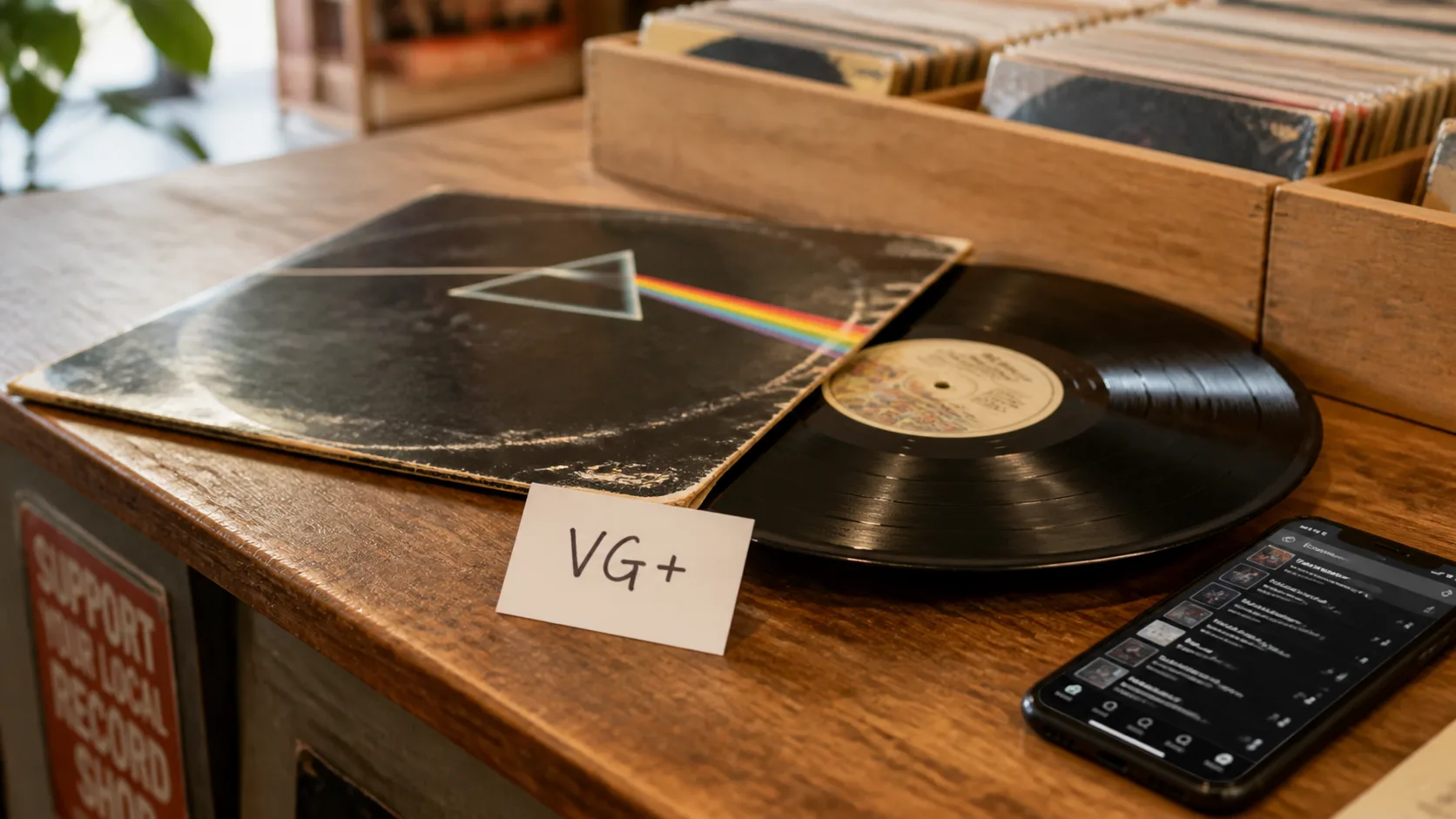
VG+ is one of the most useful grades in vinyl collecting. It is also one of the most dangerous.
On paper, VG+ sounds simple: a used record that has been handled and played, but still cared for. In practice, it covers a huge range. One seller’s VG+ is a clean copy with a few sleeve marks. Another seller’s VG+ is a record with visible scuffs, light crackle, and a sleeve that has clearly lived a life.
That does not mean the grade is meaningless. It means you need to read it like a buyer, not like an optimist.
What VG+ Usually Means
Discogs uses the Goldmine Standard for marketplace grading. Under that system, Very Good Plus sits below Near Mint and above Very Good. It is not perfect, but it should still be a strong, enjoyable copy.
A VG+ record may have:
- light paper scuffs
- faint hairlines
- minor sleeve wear
- slight signs of handling
- some background noise in quiet passages
- labels with light spindle marks
What it should not have is serious groove damage, a feelable scratch that repeats loudly, heavy warping, skips, or noise that dominates the music.
For most collectors, VG+ is the everyday sweet spot. It is often much cheaper than Near Mint, but still good enough to play and enjoy. The trick is knowing when VG+ means “honest used copy” and when it means “the seller is being generous.”
Separate the Record From the Sleeve
A listing usually has two grades: one for the media and one for the sleeve. Read both.
VG+ / VG+ means the disc and jacket are both graded Very Good Plus. VG+ / VG means the record may be fine, but the sleeve is more worn. NM / VG might be a beautiful disc in a tired jacket. VG / NM might look great on the shelf but play with more noise than you want.
This matters because collectors buy for different reasons.
If you want a playing copy, media condition matters most. If you are buying a rare pressing, a gift, or a display-worthy sleeve, jacket condition becomes more important. If you care about resale, inserts, OBI strips, hype stickers, printed inners, and sleeve condition can change the value quickly.
Do not let a clean sleeve talk you into trusting the disc. Open the jacket, check the vinyl, and treat the grades separately.
The Photos Tell You What the Grade Does Not
Online, photos are part of the grade.
A good used-record listing should give you enough visual evidence to trust the claim. For ordinary records, that might be a clear front and back sleeve photo plus a shot of the record. For expensive records, you should expect more: labels, spine, corners, inserts, and close-ups of visible marks.
Look for:
- strong light across the vinyl surface
- the actual copy being sold, not a stock image
- clear sleeve corners and spine
- labels with spindle wear visible
- notes about specific marks
- photos of inserts or missing parts
Be careful with listings that only show the front cover. That does not prove anything about the record. A sleeve can look excellent while the disc has groove wear, warps, or a repeating mark.
If the price is meaningful and the photos are weak, ask for more before buying. A serious seller should understand why.
Read Seller Notes Like a Condition Report
The seller notes are where VG+ becomes specific.
“VG+” alone tells you the seller’s summary. The notes tell you the risk.
Useful notes sound like this:
- “light sleeve scuffs, plays clean”
- “small mark on side B, does not affect play”
- “minor ring wear, no seam splits”
- “conservative grade”
- “play-tested”
Riskier notes sound like this:
- “visual grade only”
- “untested”
- “some marks”
- “plays with crackle”
- “probably VG+”
- “no returns”
None of those phrases automatically means the record is bad. But they tell you where the uncertainty is. “Visual grade only” means nobody has confirmed how it plays. “Some marks” is too vague for an expensive copy. “No returns” is not a condition detail, but it changes the risk you are taking.
For cheaper records, you may accept that uncertainty. For anything expensive, rare, or hard to replace, ask a better question before paying.
The Questions Worth Asking
You do not need to interrogate every seller. But a few calm questions can save you from a bad VG+ copy.
Ask:
Has it been play-graded? Visual grading is useful, but sound is what matters. This is especially important for jazz, classical, quiet folk, older mono pressings, and anything with visible hairlines.
Are any marks feelable? A visible hairline may be harmless. A feelable scratch is a different problem.
Does it skip or repeat? Never assume “VG+” excludes this unless the seller is reliable and the listing is detailed.
Is the record flat? Warps are easy to understate in photos. A slight edge warp may play fine; a dish warp or severe edge warp can be a problem.
Are the inserts included? The sleeve grade does not always tell you whether printed inners, booklets, posters, or download cards are present.
The best question is often simple: “Could you describe why you graded it VG+ rather than NM?”
That invites the seller to tell you the actual flaw.
VG+ in a Shop or at a Fair
In person, you have one advantage: you can inspect the copy yourself.
Use a short routine:
- Check the sleeve corners, spine, and opening edge.
- Pull out the record carefully and angle it under strong light.
- Look for hairlines, scuffs, cloudy patches, warps, and edge damage.
- Check the labels for heavy spindle marks.
- Compare catalog number, label, and country if the pressing matters.
- Ask about play-grading if the price is high.
Do not inspect only the side facing you. Turn the record over. Many bad buying decisions happen because side A looked fine and side B did not.
If the lighting is terrible, use your phone torch at an angle across the grooves. You are not trying to blind anyone. You are trying to see whether the surface has light sleeve marks or actual damage.
When VG+ Is Enough
VG+ is often exactly the right grade to buy.
It can be a great choice when:
- the record is for regular listening
- the price is fair
- the seller has strong feedback
- the notes are specific
- the flaws are cosmetic
- the record is easy enough to replace
- you do not need a collector-grade sleeve
Near Mint copies can be wonderful, but they are not always worth the premium. A clean VG+ playing copy can give you the same musical pleasure for much less money.
The key is matching the grade to the job. A VG+ copy of an album you will play often might be perfect. A VG+ copy of a rare record you are buying partly for long-term value needs more scrutiny.
When to Walk Away
Walk away when the grade and the evidence do not match.
Red flags include:
- VG+ with no photos on an expensive listing
- vague notes about “marks” or “noise”
- a seller who refuses reasonable questions
- stock photos for a used record
- “untested” on something priced like a clean copy
- heavy spindle wear on a supposedly barely played record
- sleeve damage hidden outside the photos
- a price that only makes sense if the grade is generous
Also be careful when you are buying under pressure. Record fairs, flash sales, and scarce online listings can make a risky VG+ copy feel like your only chance. It usually is not.
Add the record to your wantlist, note the target price and condition, and keep looking.
Track the Condition After You Buy
Once the record arrives, check it while the listing is still fresh in your mind.
Open it, inspect it, play the parts that matter, and compare the copy with what was promised. If the seller described a mark on side B, listen to that section. If the sleeve was graded VG+, check corners, spine, and inserts before you file it away.
Then add your own notes.
In My Vinyl+, condition notes are useful because they help you make better decisions later. Mark records that are noisy, warped, missing inserts, due for cleaning, or worth upgrading. If you see another copy in a shop six months later, you will know whether your current copy is good enough or due for replacement.
That is the difference between cataloging and collecting with memory.
The Bottom Line
VG+ is not a warning sign. It is a working grade.
For many used records, it is the grade collectors buy most happily: played, loved, affordable, and still enjoyable. But it only works when you read the whole listing, inspect the actual copy, and understand the gap between a cosmetic flaw and a play-affecting problem.
Do not buy the letters. Buy the evidence.
A good VG+ record should still feel like a record you are happy to own. If the photos, notes, seller answers, and price all point in the same direction, it can be the best value in the crate. If they do not, let that copy pass and keep your wantlist ready for the next one.
Sources: Discogs: How To Grade Items, Discogs: Seller Policy, Discogs: How To Sell Music On Discogs, What Hi-Fi?: Tips for buying used and second-hand vinyl.