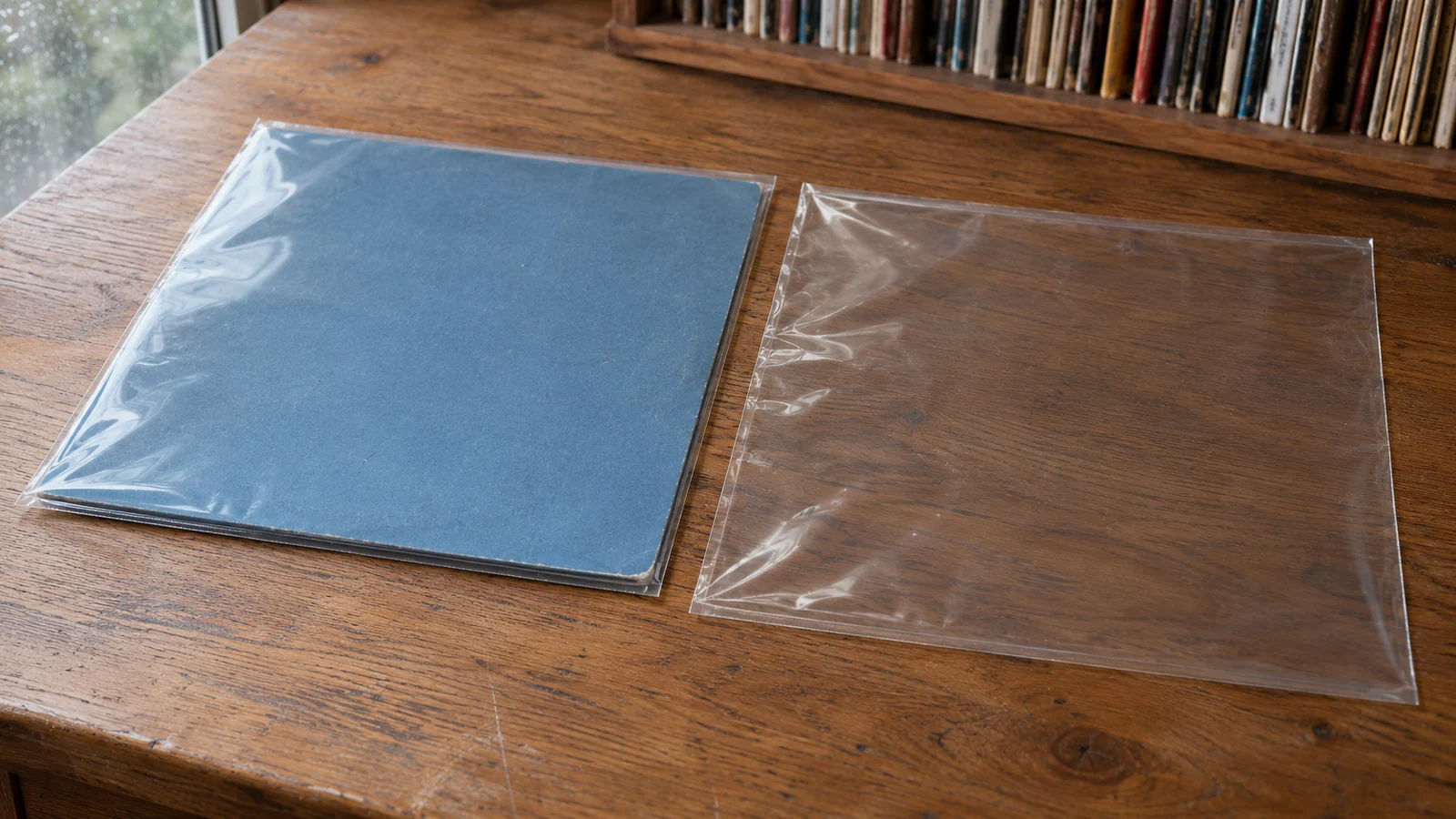
When a used LP arrives in a thick clear outer sleeve, I want to know what the sleeve is made of. A neat seam and a glossy finish do not tell me whether it belongs on the shelf for another decade.
For long-term jacket protection, I would replace a documented flexible PVC sleeve with a suitable polypropylene or polyester sleeve. The Canadian Conservation Institute advises against flexible PVC for preventive conservation and identifies those alternatives as stable general-purpose films.[1] An unidentified sleeve needs a material check, not an automatic diagnosis of damage.
This is a small shelf-maintenance job, not a reason to assume your collection is ruined. The useful distinction is between choosing better packaging and treating an already damaged object. They require different decisions.
Why flexible PVC is the concern
Plasticizers help make a plastic flexible. CCI’s Technical Bulletin 32 explains that plasticizer in flexible PVC can degrade and migrate over time. The sleeve material can yellow, deform, become brittle, and stain objects it touches.[1] A protective enclosure can therefore become a source of damage itself.
That does not justify every explanation attached to the phrase “PVC damage.” The same bulletin says suspected hydrochloric acid off-gassing has not been confirmed under normal museum conditions.[1] I would not turn that uncertainty into a claim that every sleeve releases corrosive gas on a predictable schedule.
The record itself also needs distinguishing from its packaging. Gilles St-Laurent’s 1991 guide to recorded sound, hosted by the Council on Library and Information Resources, describes vinyl discs as PVC compounds with other ingredients.[5] Sharing a polymer name does not mean a rigid LP and a flexible sleeve have the same formulation. The recommendation here concerns flexible storage film, not a claim that every object containing PVC behaves alike.
Identify the material, not the feel
Start with the sleeve packet, purchase receipt, or supplier’s specification. Look for a stated material such as polypropylene, polyethylene, polyester, or PVC. If the description says only “poly,” ask which polymer it means before treating that as enough information.
I would not identify a loose sleeve by thickness, smell, or how it bends. CCI notes that identifying plastics accurately can be difficult even in museum collections, where conservators may use analytical equipment.[2] A sleeve that feels soft is not a laboratory result, and a sleeve that looks clear is not necessarily stable.
Yellowing, stickiness, deformation, and brittleness are reasons to investigate and replace deteriorating packaging.[1][2] They are not proof of one particular chemical composition. Do not burn a corner, heat the sleeve, or apply a solvent to try to identify it at home.
For an inexpensive, unprinted sleeve of unknown origin, my practical choice would be replacement with a documented material. That avoids turning a routine packaging decision into a destructive experiment.
Choose an outer sleeve for the jacket
For a clear outer sleeve, polypropylene is a reasonable starting point. CCI describes it as a stable film with properties comparable to polyester. Polyethylene is another option, but CCI notes that some polyethylene bags and sheets have become brittle with age and favors polyester or polypropylene for long-term storage.[1] None of those names promises an enclosure that never needs inspection.
The jacket matters as well as the disc. NEDCC’s guidance for paper artifacts identifies polypropylene, polyester, and polyethylene as preservation materials, while warning that additives and coatings affect suitability.[3] I would choose a supplier that states the composition rather than rely on “archival” as the entire product description.
There is a specific caveat for fragile artwork. NEDCC warns that polyester’s static charge can lift loose media and affect flaking inks.[3] If a cover has powdery decoration or lifting print, do not slide it into a tight plastic enclosure and assume the material name makes the handling safe.
Keep this separate from the inner sleeve touching the record. The Library of Congress recommends high-density polyethylene replacement sleeves for grooved discs.[4] An outer sleeve protects the package. It does not replace an appropriate inner sleeve.
Audit one shelf without damaging the covers
I would work on a small group at a clean table, with replacements ready. The Library of Congress advises clean, dry hands and handling grooved discs only at the edges and label areas.[4] Keep exposed playing surfaces away from the work area while inspecting the jackets.
- Check any surviving sleeve packaging and save the material specification. Separate documented flexible PVC sleeves and unidentified sleeves for attention.
- Support each jacket on the table. See whether it moves freely inside the outer sleeve before trying to remove it.
- If the plastic sticks to the print, stop. Do not pull harder or add heat to loosen it. CCI identifies surface loss during careless separation of stuck materials as a conservation risk.[1]
- For a jacket that slides out freely, inspect the cover and old sleeve separately. Note discoloration, tackiness, cracks, or transferred print without assigning a chemical cause.
- Put an undamaged jacket into a suitable replacement with enough room to slide without force. Try the size on a gatefold before ordering sleeves for an entire shelf.
- Record the replacement date and material, then return the record upright with support. Keep it away from direct light and heat sources, following Library of Congress storage guidance.[4]
Leave anything stuck or fragile out of the routine replacement pile. A conservator can assess a valuable cover before an attempted separation removes part of its artwork.
Treat haze and sticking as separate problems
Replacing an unsuitable sleeve changes the storage arrangement. It does not establish what caused a cloudy patch on the record, or prove that a wash will remove it. I would not use a photograph of haze as a diagnosis of plasticizer migration.
Record the symptom precisely. “Outer sleeve sticks to front cover” is more useful than “PVC ruined the album.” If the disc also has an unusual deposit, keep that observation separate and seek format-specific advice before trying a treatment. These enclosure sources do not establish a guaranteed cleaning cure.
An original printed plastic sleeve creates another decision. Photograph its artwork and how it belongs with the release before separating it, if separation is safe. I would seek conservation advice for storage of a deteriorating original rather than put it back against the jacket to preserve the package’s appearance.
For the paper components inside the album, the Journal’s guide to preserving record inserts and folded posters covers a different part of that job. Replacing an outer sleeve need not mean discarding the material that documents the release.
Keep the material information with the sleeves
CCI recommends regular inspection of plastics for signs of decay.[2] Keep the supplier’s specification with the unused sleeves, so the next shelf check does not begin with the same uncertainty. Check their condition when you take records out, rather than assign every plastic a permanent pass.
Start with the next used LP you bring home. Identify its outer sleeve, replace unsuitable or unknown disposable packaging, and stop if the cover sticks. The goal is a jacket you can remove safely from an enclosure whose material you know, not a more expensive sleeve with an unexplained promise.
Sources
[2] Canadian Conservation Institute: Care of objects made from rubber and plastic, CCI Notes 15/1
[3] NEDCC: Storage enclosures for books and artifacts on paper, Leaflet 4.4
[4] Library of Congress: Care, handling, and storage of audio visual materials