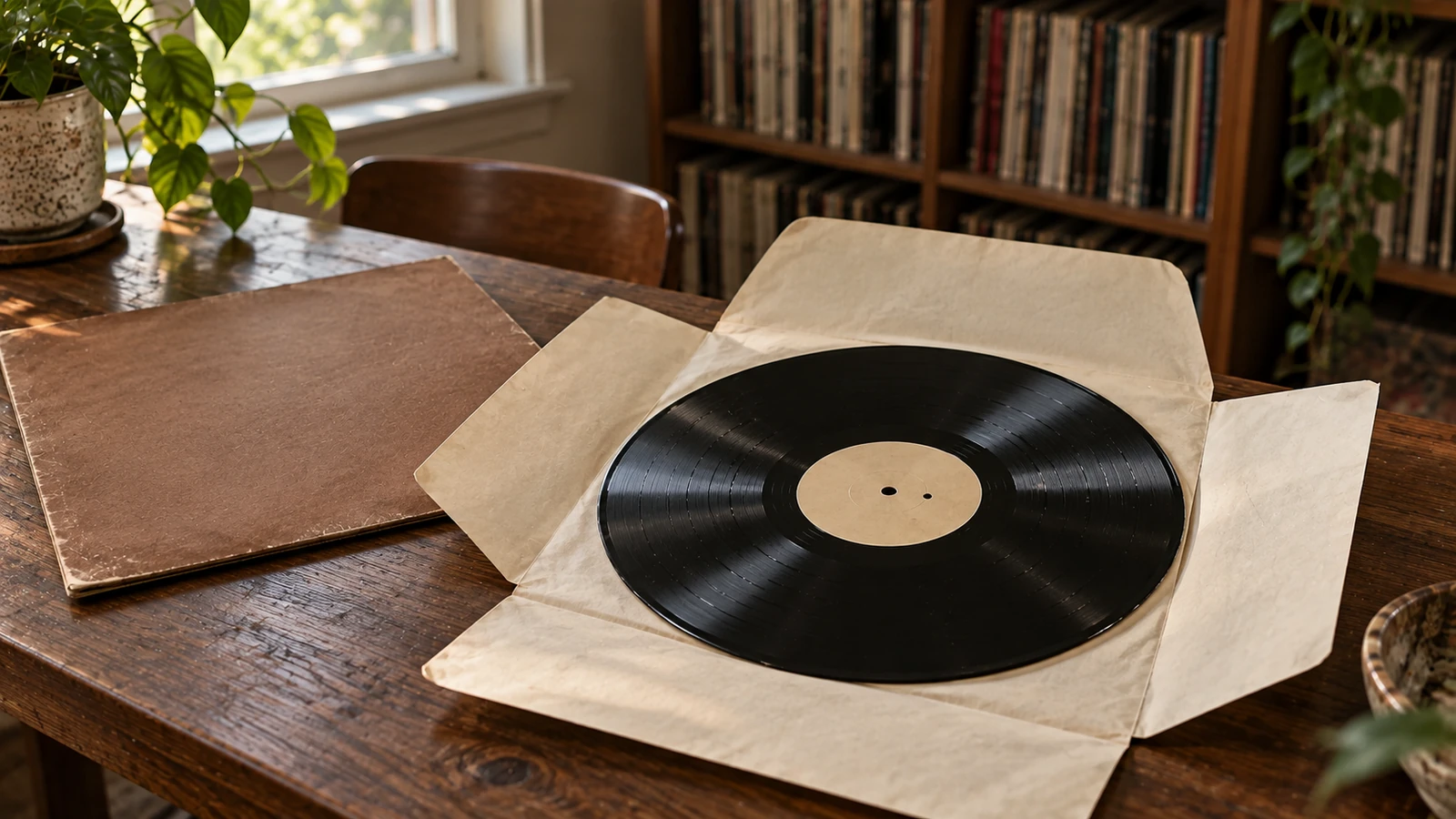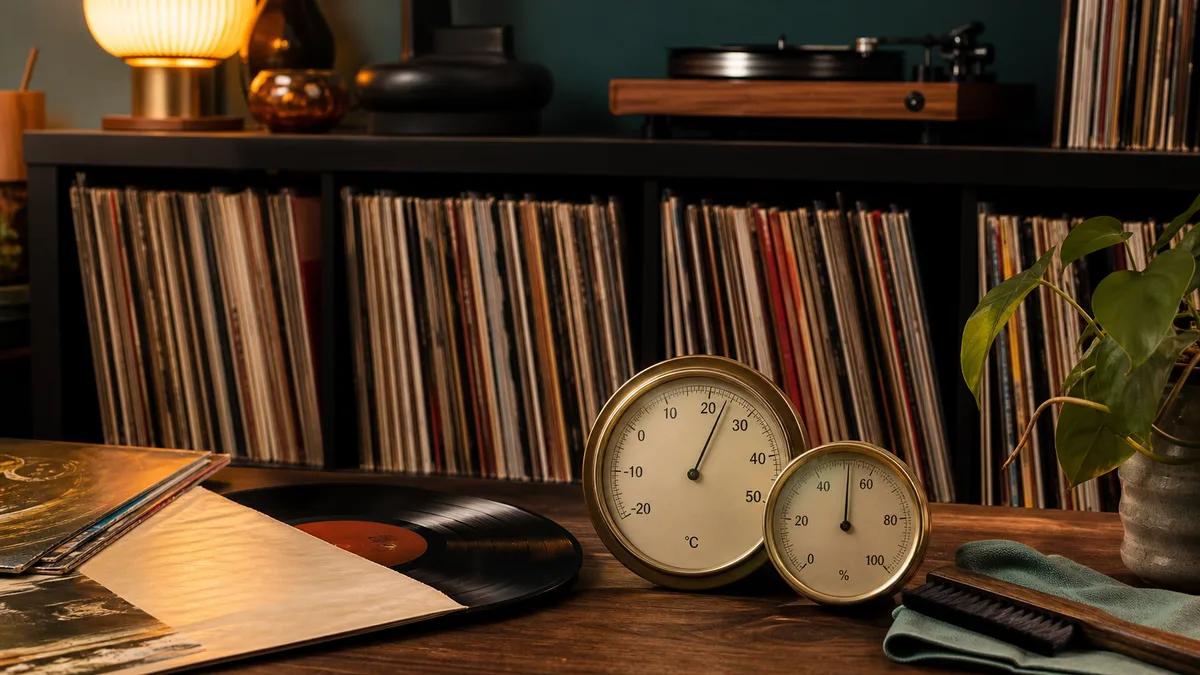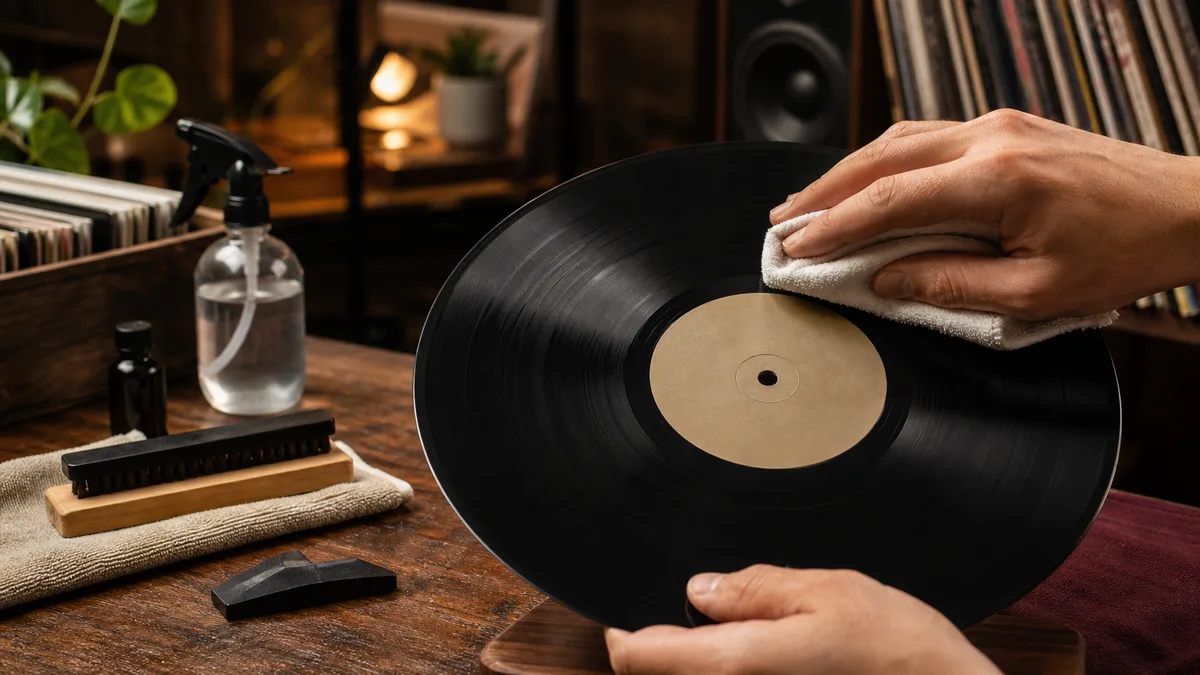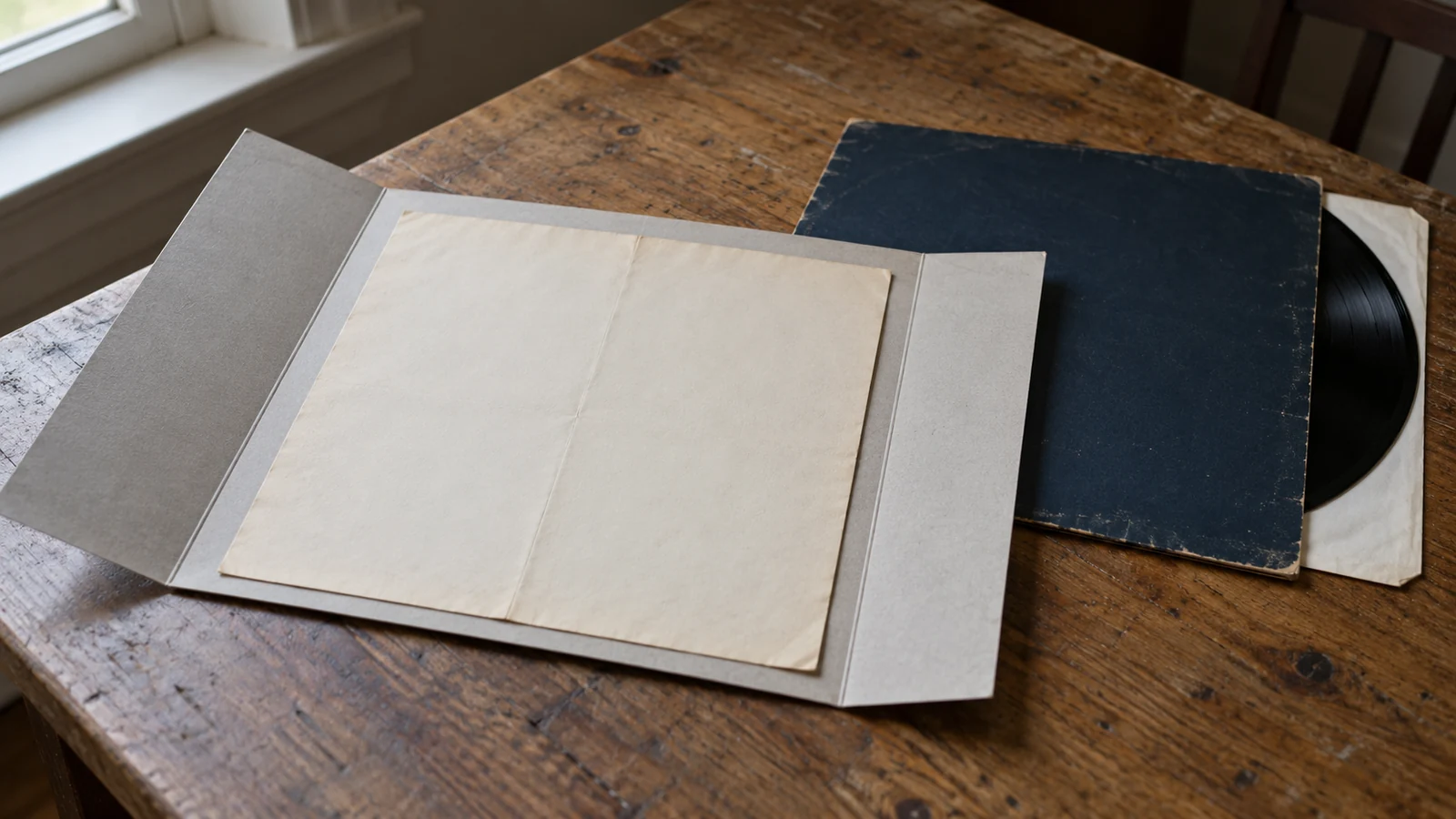
I can put a record safely back in its sleeve and still damage the paper that came with it. Vinyl record inserts need their own handling routine, especially when a lyric sheet has a weak fold or a poster no longer opens without resistance.
Yesterday’s World Day for Audiovisual Heritage is a useful reason to look beyond the disc. UNESCO’s October 20 announcement describes this year’s observance and work to protect endangered recordings.[1] For my shelves, I would make the task smaller. Check the loose paper inside one album, keep its connection to that copy, and avoid a repair that creates another problem.
The guidance below applies established paper-conservation advice to record packaging. It is not a new treatment method or a promise to restore a damaged insert. The aim is to let you consult the words and pictures without making the original worse.
Record what belongs with the album
Before rearranging anything, photograph the jacket and its loose contents together. Then photograph each sheet’s front and back if you can do so without forcing it open. I would record the album title, the identifying details of my copy, and where each item was found.
Keep observation separate from certainty. A concert flyer tucked into a used LP might have belonged to a previous owner rather than the original release. Write “found inside this copy” unless you have evidence that it was supplied with the album. A handwritten dedication is worth recording without guessing who wrote it.
If fragile paper needs a separate folder, give the folder and your collection note the same reference. An example might be “paper folder 07, blue cabinet, upper drawer.” That is my suggested filing method, not a requirement from an archive. Its purpose is to stop a safer storage arrangement from separating the insert from its history.
Put new identification on the enclosure rather than adding it to the collectible. The Library of Congress recommends pencil rather than ink for necessary inscriptions on paper and warns against paper clips, rubber bands, tape, and glue.[2] I would not attach a note to an original insert with any of those materials.
Open a fold without trying to erase it
Clear a table, wash and dry your hands, and move drinks away. Support the sheet as you lift it rather than letting one corner carry its weight. The National Archives advises gentle handling with two hands and specifically warns against back-folding documents to flatten them.[3]
That warning matters with a poster that springs back toward its old shape. Reversing the fold may look like an easy correction, but the Archives notes that paper can break along fold lines. Stop if opening the sheet appears to cause damage.[3]
I would not pull a reluctant fold open just to complete a photograph. Record the visible portions and note that the item remains folded. A complete image can wait for advice from a paper conservator if the paper is brittle or the fold is failing.
For a sound sheet that opens without resistance, support it on a clean surface while reading it. Do not make a new crease to fit a scanner or close the record jacket. The useful result is access to the information, not a sheet that looks as though it was never folded.
Choose an enclosure for the paper and its markings
For ordinary loose printed sheets, look for a supportive folder made from acid-free, lignin-free stock. Both the Library of Congress and NEDCC recommend chemically stable enclosures. NEDCC explains that acids from poor-quality folders can migrate into the documents they hold.[2][4]
Check the material description before buying. NEDCC cautions that an alkaline pH reading alone does not prove preservation quality. A supplier should be able to explain the enclosure’s composition, not merely put “archival” in its name.[4]
A clear polyester sleeve can reduce handling of a fragile sheet, but it is not right for every surface. NEDCC warns that polyester’s electrostatic charge can lift loose media, including soft graphite, charcoal, and flaking ink.[4] A sheet with powdery or lifting marks needs advice before it goes into plastic.
Buffered paper enclosures also have exceptions. NEDCC lists materials sensitive to alkalinity, including some dyes, pigments, and photographs.[4] If the insert includes an original photograph, unusual artwork, or uncertain media, ask a conservation supplier or conservator which enclosure suits it. Do not assume one folder specification fits every item in the jacket.
Give a poster enough room
The enclosure must support the whole sheet. The National Archives recommends containers large enough to hold originals without folding or bending them, and warns against overstuffing boxes or leaving edges sticking out.[5] Measure the item before ordering its folder and storage box.
An oversized poster does not have to return to the LP jacket if that means repeated folding. The Library of Congress recommends unfolded flat or rolled storage for oversized paper.[2] For a poster with weak existing folds, I would ask about supported flat storage rather than introduce another shape at home.
Store the folder somewhere you can retrieve it without dragging it past other objects. Keep it away from direct light, radiators, and locations at risk of leaks.[2] A new enclosure helps only if its location does not introduce another hazard.
If you want the artwork on the wall, display a copy. The National Archives recommends copies for display because light can fade inks and colored papers.[3] Keeping the original dark is a more defensible choice than assuming a frame makes permanent display harmless.
Leave repairs out of the first session
A split fold can make tape feel necessary. The National Archives advises against mending documents with glue or tape.[3] Put the item in a supportive enclosure and keep any detached pieces with it rather than trying to make a usable hinge.
Do not turn the same session into adhesive removal. If a sticker is the separate problem, read the guide to price stickers on record sleeves before attempting anything. A loose insert and a printed jacket can need different decisions.
For brittle paper, flaking media, or damage that ordinary support cannot address, consult a paper conservator. The Library of Congress identifies conservation treatment as the next step when basic care and storage measures are insufficient.[2] A collector can improve housing without attempting treatment.
Check one album tonight
Here is the limited session I would choose:
- Pick one album with a loose lyric sheet, poster, or personal note. Clear enough table space to support its contents.
- Photograph what you can access safely. Record whether the paper came with the release or was simply found inside this copy.
- Check folds and edges without pulling, back-folding, or testing a repair. Stop if the paper begins to break.
- Choose a correctly sized enclosure after checking the paper and its markings. Leave uncertain materials for specialist advice.
- Note the storage location beside the album’s identifying details. Keep any detached fragments with the original.
- Use a photograph or copy for routine reading when that avoids repeated handling. Return the original to its protected location.
I started with the possibility of protecting a disc while damaging its insert. Before you put tonight’s album away, check the paper too. If it needs better support, record where it belongs and choose the enclosure before opening it again.
Sources
[1] UNESCO: World Day for Audiovisual Heritage, Protecting memory at risk, October 20, 2026
[2] Library of Congress: Care, Handling, and Storage of Works on Paper
[3] National Archives: Treating Memories as Documents, by Mary Lynn Ritzenthaler
[4] NEDCC: Storage Enclosures for Books and Artifacts on Paper
[5] National Archives: How to Preserve Family Archives, Storing Family Papers and Photographs