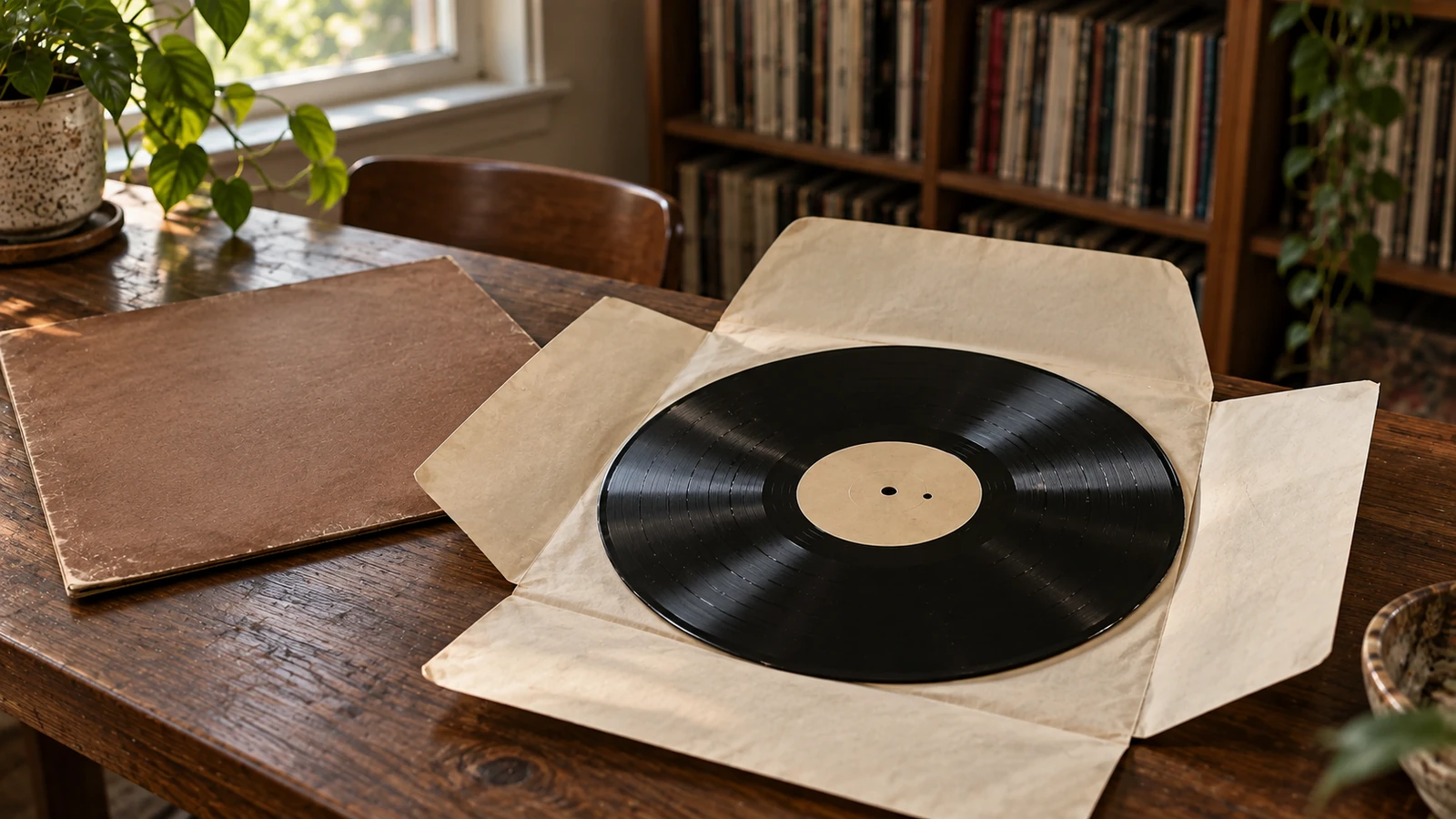
An unfamiliar black disc turns up in a record collection. The label is handwritten. There is an extra hole near the spindle hole. You want to clean it, drop the needle, and find out what is on it.
Pause there. A lacquer disc, often called an acetate, can look much like a vinyl record, but its construction and preservation problems are different.[4][2] The useful first question is not “What is it worth?” It is “Can I identify this without putting the recording at risk?”
This guide is for recognising a possible lacquer and deciding what to do next. It is not a home-cleaning recipe or permission to test an unknown disc on your usual turntable.
What an acetate record actually is
IASA, the International Association of Sound and Audiovisual Archives, distinguishes pressed copies from instantaneous recordings made directly on a recording carrier.[4] Lacquer discs belong to that second group, and many instantaneous recordings are unique rather than mass-produced copies.[4]
The familiar name “acetate” is misleading.[4] The common historical construction is a rigid base, usually metal or glass, coated with cellulose nitrate lacquer that carries the grooves.[4] Cardboard bases and other recording-surface materials also exist.[4]
That distinction matters more than the nickname. You are dealing with a recorded coating attached to a separate base, not simply assuming the disc follows the care rules for a pressed LP.[4][2]
An unusual label does not prove that the recording is unique, famous, or valuable. I would document what is actually there before attaching a story to it.
Look for clues without testing the material
Inspect in good light, with as little handling as possible. The Library of Congress includes lacquer discs in its advice to handle grooved records only at the edge and label areas, never on the playing surface.[7]
IASA identifies several useful clues:[4]
- A visible base at the edge or centre hole. The material underneath the lacquer may show between the coated faces.[4]
- Typed or handwritten information. Lacquer labels often carry details added individually rather than the printed information on a retail release.[4]
- An extra hole near the centre. Some discs, particularly those without paper labels, have additional off-centre drive holes.[4]
Treat these as clues to investigate together. A handwritten label alone is not a material test, and a blank label tells you too little to settle the question.
Do not scratch an edge to expose the base, flex the disc, peel the coating, or rub a deposit to discover how it feels. IASA warns against mechanical and thermal stress because internal stresses in a lacquer disc can be difficult to detect.[2]
If the disc is stuck in its sleeve, cracked, or shedding pieces, stop the inspection rather than forcing a better view. Send photographs of what you can see to a recorded-sound preservation specialist.
A white film may be deterioration, not ordinary dirt
An old recording can have deposits caused by its own deterioration.[1][6]
IASA describes white or grey deposits on lacquer discs caused by material migrating out of the recording layer.[1] They can resemble mould.[1] The Library of Congress has independently analysed degraded lacquer discs and found stearic and palmitic acids in the surface deposits, associated with the breakdown of a castor-oil plasticiser.[6]
So a cloudy or waxy-looking surface is not an invitation to apply your usual record wash. Nor can you diagnose mould or chemical deterioration reliably from a casual photograph.
Look for warning signs without touching them:
- White, grey, oily-looking, or waxy-looking deposits.
- Cracks or a fine network of lines in the coating.
- Lifting edges, flakes, or areas where the recording surface is missing.
- A broken or bent base.
The coating can become brittle and shrink while the base does not.[2] The resulting stress can crack the lacquer and detach the layer that holds the sound, a process called delamination.[2] Cleaning cannot put missing grooves back.
Photograph the symptoms and describe them literally. “White deposit across the outer grooves” is better than an unconfirmed diagnosis of “mould” or “vinyl residue.”
Do not borrow a vinyl-cleaning routine
For a suspected lacquer, my practical rule is to leave cleaning to someone who can identify the construction and assess its condition first.
IASA explicitly says lacquer discs should never be exposed to alcohol.[1] It also says solvent and cleaning-solution decisions need appropriate specialist technical advice.[1] An alcohol-free bottle is not, by itself, evidence that a treatment suits this particular disc.
Water is not a universal fallback. IASA notes that some discs have paper or card beneath the playing surface, while some early recording surfaces are gelatine and can suffer irreversible damage from liquid treatment.[1]
That means no experimental soaking, scrubbing, ultrasonic cycle, or household solvent. Do not extrapolate a method for a sound vinyl LP to an unidentified instantaneous recording.
The Library of Congress research is useful here precisely because it is not a simple household recipe. Its researchers tested both deposit removal and what a solution might remove from the disc itself.[6] The published findings also flag further safety evaluation of one chemical ingredient.[6]
Successful treatment in a preservation laboratory is not evidence that improvising it at the kitchen sink is safe.
Arrange a transfer, not repeated test plays
A clean-looking lacquer does not earn a long delay. IASA gives these discs high transfer priority because they are inherently unstable, and its handling guidance says their remaining life is unpredictable.[4][2]
For a collector, the next step is to contact a recorded-sound archive, audiovisual conservator, or transfer engineer with specific experience of lacquer discs. Ask whether they assess condition before playback and how they handle cracked, flaking, or unidentified carriers.
I would not use an ordinary listening session as the identification method. Ask the specialist to establish the recording format, playback speed, and suitable replay equipment before planning the transfer. Do not assume an old-looking disc belongs on the same setup as either your LPs or your shellac 78s.
If the disc is warped, do not heat it or press it flat. IASA strongly advises against attempting permanent flattening of instantaneous discs and warns that stressing a lacquer surface can damage it.[1]
Our home vinyl digitization guide is for a different job. Use it for a suitable, identified vinyl record, not as a shortcut around assessing an unfamiliar lacquer.
Keep the disc supported while you get advice
The Library of Congress recommends upright storage for grooved discs, with support across the full face of the sleeved disc.[7] It also advises against mixing different disc diameters in storage.[7]
For an intact, already housed disc, keep it supported in a cool, stable place away from direct light and heat while arranging advice.[7] Do not leave it leaning loose against larger LP jackets or squeeze it into a crowded shelf.
If the coating is loose or the sleeve is stuck, ask about housing and transport before trying to replace the sleeve yourself. Avoid making a fragile item travel merely so somebody can look at it. Start with photographs and an honest condition description.
Keep the original label, sleeve, and accompanying notes together as information, even if a specialist later recommends different protective housing. Do not write directly on the disc or add a sticker to identify it.
Make the specialist’s first decision easier
Send a short enquiry with the details you can gather without extra risk:
- Photographs of the label and visible surface, plus the edge or holes if already accessible.
- The wording on the label, including uncertain or unreadable parts.
- The disc’s approximate size and any speed written on it.
- Visible cracks, flakes, deposits, bends, or sleeve adhesion.
- Where it came from and any related paperwork.
- Any cleaning or playback you know has already happened.
Keep observations separate from guesses. “Possible lacquer, material unconfirmed” is a useful description. “Rare master recording” is not, unless you have evidence.
The first success is identifying the object without altering it. The next is deciding how to preserve the recording. A familiar-looking black disc is not always a familiar care problem.
Sources
[1] IASA TC04: Cleaning and restoration of historical recordings
[2] IASA TC05: Lacquer construction, deterioration and transfer priority
[4] IASA TC04: Identifying instantaneous recordings and lacquer discs
[6] Library of Congress: Research on cleaning degraded lacquer discs
[7] Library of Congress: Care, handling and storage of audiovisual materials